
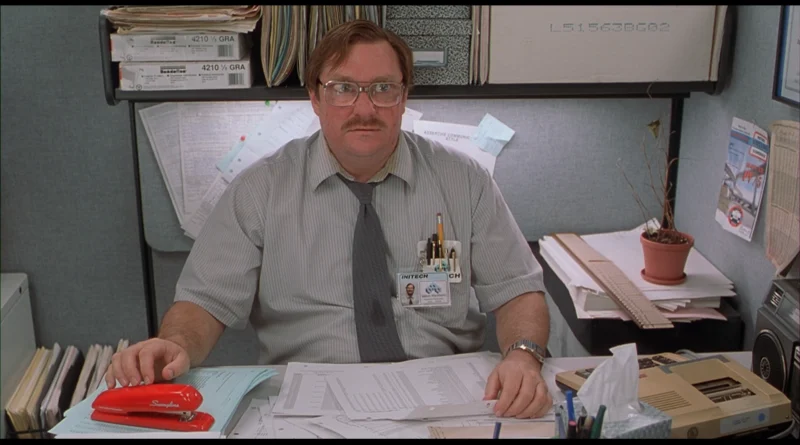
Office Space (1999): The Corporate Cult Favorite with An Odd Plot
One of the most endearing movies about corporate culture (especially in American type of offices) is none other than Mike Judge’s Office Space (1999). Coming out around the period where the dot com boom really took off, Office Space was poorly marketed yet became this cult classic, often cited for the cynical view of the dehumanization of people in cubicle “culture” (a term you can only put in quotes since the idea of culture in a company is almost an oxymoron). While cubicle culture might have slowly eroded over time, many elements from this movie can still be cited or found. But for me, this movie, in truth, is more about the odd types of characters you might find in a corporate environment rather having a sensible plot and rich people. Unlike my other rants about movies, this one won’t necessarily do an actual scene-by-scene review but more of an analysis of the movie.
First, I want to talk about why this movie popped into my head today. Quite honestly, I haven’t seen this movie in quite a while and don’t have it readily available. However, back when I used to work in larger companies, I periodically would slip this classic into the DVD player (or maybe it was on a hard drive somewhere) and let myself escape in Peter Gibbons’ (the main character played by Ron Livingston) journey in trying to do nothing. As an office worker, I found the humor generally cathartic and could be cited in sardonic exchanges about management with other coworkers. The movie is infinitely quotable with classic lines such as “watch out for your cornhole,” or “I have people skills!” to “Someone has the case of the mun-days.”
Yet as I sit here on my couch doing my daily blog, the idea of being in another cubicle setting is so far distant compared to my current disposition that there really is no relevant reason why this movie should have manifested. I think part of the trigger though was being contacted by a friend/ex-colleague, who messaged me earlier this morning and told me he’d been wanting to contact me. However, probably because of a combination of work, having a new child and dealing with some political campaign stuff, he’s been inundated with life. My first instinct in hearing the business part was assuming he was overworked just because of how most tech companies really putting their foot to the gas pedal in squeezing every drop of blood from their workers while they can still do it in the current environment. Maybe that image made me think of Office Space and my personal PTSD of dealing with corporate environments.
Regardless, my mind went down this mental rabbit hole that led me to Office Space and the possibility of writing up a review, since lately I’ve been struggling to find something worth writing about. Unfortunately, as I mentioned, I don’t currently have a copy readily available nor do I actually wish to watch the movie at this moment mostly because it invokes bad memories of the general work place. Instead, as I pondered the movie some more, I recalled a quote from a while back that I read about the movie: it really has no plot.
If you examine Office Space closely, you’ll realize that the characters really aren’t characters but types of people you might encounter in the work space. Also, the plot, if there is one at all, makes no sense. When you dig through a lot of the nonsense and try to come up with a one sentence summary of what happens in the movie, it boils down to some disillusioned white dude hates his life and decides he wants to do nothing. Once you see the movie in this manner, it changes a lot of the context of the movie.
First, let me talk about how there really aren’t people in this movie but character types. You have Peter Gibbons who, for some reason, hates his job and general life. We know almost nothing about this guy. Why does he want to do nothing and just go fishing? During the consultant interview process, Peter admits that he’s not lazy then talks about motivation. Everything he describes sounds reasonable and the person he’s projecting is very relatable. But as an individual, he still makes almost no sense to me.
Part of the character starts to fall apart just when his neighbor Lawrence shows up and tells Peter that anyone can do nothing, citing his own cousin, who is broke and “don’t do shit.” Then Joanna, played by Jennifer Aniston, critiques Peter’s lack of plans in asking how he intends to pay for bills or support himself. All he can reply with is, “I don’t think I’m going to do that either.” I mean, it’s funny, bold and idealistic as well as a way to charm Joanna, but the line is kinda thrown out there while there’s almost no consequence nor true follow up in how Peter will handle this. Instead, Peter’s life suddenly “improves” and things go his way magically.
Maybe that’s the comedy side of things but it does call into question this weird world that’s being constructed. It’s not completely outlandish like say Harold and Kumar riding a high tiger in trying to get to a White Castle. But for a movie that has more “realistic” elements, you have to acknowledge the semi-fantasy element portion of it as well as what the actual intent of such a statement is here. Like is Mike Judge actually suggesting that people stop paying their bills and do nothing?
I think this is where the movie gets really muddied because the plot and characters are somewhat socially subversive. Sticking with Peter, I have to question why and how this guy became like this. We know almost nothing about his background. The only tiny hint is derived from the profile that the two consultants pull out on him where it shows Peter has a decent degree. But it makes you wonder why he decided pursue this job in the first place if the environment makes him miserable.
Beyond that, Peter’s character loses a lot of sympathy from me because he basically comes from a privileged background. While I’m certain many computer worker types can relate to the big picture aspects of Peter’s misery, he comes off sounding really self-righteous at times such as when he mentions how humans weren’t designed to be jammed in small cubicles. I can understand the sentiment but as someone who worked in both cubicle farm-like office structures vs the open space place, I can say that I prefer the cubicle farm setting better for privacy. But we don’t understand why Peter is really miserable. We can only infer part of this because of the annoying environment he works in.
And this is where things get weirder. Like if he hates his company so much, why does he stay? Why does he continue to put up with things until the moment he gets therapy and witnesses the psychologist having a stroke? Even after the mystical epiphany, Peter continues to show up to work, even though he’s doing it under his terms. Later on after the company burns down because of Milton setting the building on fire, Peter does show up to a construction company. So he’s still working (and apparently he’s got a new boss that sounds exactly like Lumbergh, even though that part is only shown in the deleted scenes). But does it really change his life? He seems to have adjusted and mentally justified the new job but we don’t see more of him.
But as I deconstruct his character, Peter becomes really problematic because we never learn that much about him. Through a contemporary lens, he simply sounds lazy and entitled. I think if his character had some background like maybe what he originally wanted to do vs how he ended up trapped in this field, I would feel more empathetic towards him. But he comes off as shallow and almost a reflection of the white American upper middle class type.
Again, I emphasize the word “type”. Of all the characters in the story, Peter ought to have been far more fleshed out. But this is probably one of my general critiques of Mike Judge’s writing where the people in his work are generally those he can typecast for a cheap laugh. We laugh at these characters because we can see them too around us. Like Drew with the “O face” is someone you probably have encountered a few times at varying work spots. Or the annoying support woman. And Lumbergh certainly is your prototypical middle management, pointy haired boss figure that most workers demonize. Even if they’re recognizable, they don’t feel human as well rounded people.
That then leads me to talk about the problems with the plot. The plot itself is really shallow when you remove all these encounters. It really is about Peter’s quest/journey to do nothing. While Office Space itself was supposedly based on Mike Judge’s shorts about Milton, the movie mostly films around him as this oddball that gets interleaved around Peter’s situation. Peter is treated as the main character because the movie takes this type that was effectively based on Mike Judge’s transient period working in Silicon Valley and shows this sparse view of office culture. I suppose based on Mike Judge’s experience, his conclusion was to GTFO especially because he found more success and happiness in animation and film. But I get the impression that he privately isn’t a very satiated person in general.
But the plot is actually pretty stupid if you think about it. Here, you have this lazy, entitled, white worker that decides to effectively fuck off. He fails forward once he decides that apathy is the way to go and seems to be validated by the materialism shown by the procuring of the beautiful hapless waitress and his undeserved promotion. Then he decides to involve his colleagues, who might be considered work friends at best, into an illicit scheme to defraud his company of money. When he mishears that his girlfriend might’ve been with his manager, Peter goes ballistic because he’s an insecure prick that leads him to having a major fight with her. Once he understands that he’s really a delusional piece of shit and that he’ll probably go to jail for his fraudulent scheme, he works up a fake conscious to give back the money/letter to the company but immediately decides against it but inadvertently cannot get it back because the envelope had slipped under a door. It’s only by serendipity that Milton shows up to discover the money and burn the office down along with any evidence to implicate Peter, Michael Bolton and Samir. Despite this effort, Peter still ends up working but for a construction company, which doesn’t seem to truly placate his issues (which is his laziness), although he does still manage to get back with Joanna. So his only net positive in truth is dating Joanna.
We don’t really find out if Peter’s life improves though because Mike Judge admitted that he didn’t want to endure the problems he experienced in making this movie. I think Peter is just someone who is a miserable son-of-a-bitch, someone who is entitled and insecure but lacks actual self-awareness and is incapable of making significant change because he’s a mediocre person. But maybe that’s the point. Maybe Peter is just a reflection of the vast majority of American office worker types, who wish nothing more than to be sitting on a boat casting their line and getting sun while sleeping.
Now, one might ask why am I getting so down on Peter? It’s not really Peter as much as how he’s written as well as the host of other characters in this show. I have to cross reference Peter with another character facing a similar plight in Yamada as Densha Otoko. I would argue Yamada and Peter are very similar in that they hold office jobs, are miserable and lack a sort of self awareness. Peter though had a beautiful girlfriend prior to Joanna but seemed miserable around her because she was a wretched person (more entitled white America for you). Yamada-san wasn’t as entitled but still to me is quite shallow as a person. We get a limited amount of knowledge about him as a person in terms of how he became an otaku except when he finally comes out to Saori. Even if we can identify with him thematically (the outcast geek type), lacking that historical aspect where we’ve seen his childhood and teenage development leading to his state makes his situation less relatable much like Peter. So in both cases we can identify with their circumstances but not as people.
I’m not saying Office Space isn’t a great movie in its own right. I love the de-glamorization of work culture. I have seen the various types of people Mike Judge gives us a brief glimpse of from the movie. Much of the movie quotes can be used as anti-corporate slogans. But I think the movie is an interesting case where if you can divorce yourself from the comedic aspects and dive deeper into the people and plot, you’ll see that it’s also severely flawed as well as not really providing a truly satisfying conclusion.