
Shaw Brothers The Boxer Rebellion 1976 Review
Although I haven’t seen this movie in a while (I have it somewhere), it was something on my list of old Shaw Brothers kung fu movies I wanted to write about. Originally, I had watched this movie on the old Black Belt theater back in the early 80s on channel 11 on Saturday mornings/lunch time hour. Black Belt theater generally had the better kung fu movies compared to channel 9, 5, 13 and other local stations because they mostly were Shaw Brothers flicks. But The Boxer Rebellion was one of those with some of Chang Cheh’s favorites back when he was in his prime as a director and this movie had a few very memorable parts worth discussing.
The Boxer Rebellion is a period piece done on the actual event of the Boxers in China where a group of fighters called the Boxers were part of a secret society known as the Society of Righteous and Harmonious Fists. These people were anti-Christian, anti-foreign and ant-imperialist. The movie itself uses the main viewpoint of the rebellion through several martial artists who become involved in this group. The main three are played by Fu Sheng (Tsang Hin Hon), Chi Kuan-Chun (Shuai Fang Yun) and Leung Kar-Yan/Beardie (Chen Chang). It’s worth noting here that this may have been Leung Kar-Yan’s only appearance as a heroic figure in a Shaw Brothers production because mostly he was cast as a villain. These three men are effectively blood brothers looking to uphold the honor of their country and join up with the Boxers in hearing about the Boxers’ intent on purging China of the foreign invasion.
Now, there is a split between the Chinese version and the non-Chinese (English dubbed) ones. The Chinese version adds more to the plot in giving a great deal of weight to the main shadow figure of Empress Dowager played by Li Li-Hua. The Chinese version starts out with Dowager watching an opera performed in her thrown room and she’s portrayed as this regal but ignorant figure, surrounded by sycophants who feed her bad information. Despite their fawning and desire for her favor, these sycophants do try to get her to move in a certain direction but do hide important information, which suggests that her decision making had been influenced by layers of politics.
On the other hand, the non-Chinese version starts with Tsang practicing kung fu and generally doesn’t go into as much detail on the political side as it focuses more on the action. Given how the Chinese version is meant to be more symbolic and starts off slower, it’s not a surprise how a second cut was made for the non-Chinese based audiences. Instead, the focus becomes more on the three main characters and their strife. Tsang is a typical Fu Sheng character, likeable, hot headed, youthful and ready to get into trouble. Shuai is the most level headed of the three, well read and cautious. Chen is the most fervent in his gung ho patriotic attitude as well as a hot head but he does have a good heart.
Both Chen and Shuai briefly converse about the feats of the Boxers, including a particular individual named Chang Chun Jiang played by Bruce Tong, who is a famous pugilist/practitioner of the iron bell technique, which is effectively a method that allows one’s body to be near weapon proof. Despite Chang’s impressive ability, Shuai has his doubts especially when it comes to a human’s immunity to guns. However, Chen is a believer and encourages Shuai to check out an upcoming rally. Shuai still remains dubious but believes that using Chang’s presence as a way to bolster up the confidence in the Chinese army, they might stand a chance.
Eventually, an incident breaks out in a village where a white foreigner with his Chinese lackey sparks a riot when the poor villagers beg for aid. One man’s baby dies and he accuses the foreigner and lackey of betrayal, attacking the foreigner. However, the foreigner brandishes a gun and shoots the father dead while Tsang watches in the background. As the foreigner takes off, Tsang follows behind and hitches a ride in the man’s carriage. He plays around with the foreigner until the guy takes out his gun once again to try and shoot Tsang. Tsang leaps off the carriage with only a bullet hole through his shirt before re-grouping with his two friends as they continue to make their way to the temple where the Boxers are holding a rally.
The scene at the temple is invigorating as numerous Boxers dressed in yellow and red watch a ritual take place. The three also watch along with two of the empress’ key advisors. Chang is brought to show off his kung fu as none other than Shaw Brothers perpetual favorite villain Ma Fu Yi, I mean Wang Lung-Wei, playing Li Jung Ching, performs a ceremony that would “protect” Chang and the Boxers with a spell. Two other boxers approach Chang with massive swords and deliver hard blows against Chang’s back and chest, but he repels them, which causes the Boxers to cheer, believing that the spell worked while the advisors have visually confirmed that something special is happening. Also, Tsang and Chen get caught up in the rally but Shuai remains skeptical, casting a disapproving glance towards Tsang, which calms his friend.
In the back, the three greet Chang as Tsang goes to inspect some statues. Li Jung comes in and admonishes Tsang for blasphemy in touching the statues but Tsang mentions how he sees through the spells. Li Jung considers it nonsense until Shuai corrects Li Jung in saying that the spells are there to give the Boxers courage. Li Jung smiles back at Shuai as it becomes clear that Li Jung is nothing more than a master manipulator who found his freak show act. However, the stakes are much higher with thousands of lives at stake. Also, Li Jung recognizes that Shuai is going to become an eventual menace to him but does nothing at the moment with Chang playing mediator. In turn, the three men are given positions to help train the troops.
Chang is given a scene where he practices a polearm with the Boxers while Tsang and Shuai discuss what they had witnessed. Tsang wonders whether or not Chang can withstand the guns or if the spells are real. Shuai tells him straight out no, which causes Tsang to be concerned. However, Shuai believes that using the moment as a way to bolster the courage of the Chinese might be the start to push for a revolution. He points to a book by a political thinker about revitalizing China, which I think is the basis of philosophy for the Boxers.
At any rate, Li Jung decides to act and directs the Boxers towards a Japanese encampment. Chang and Shuai have a conversation while the Boxers celebrate the night before the attack. Chang knows that his fate is imminent and that he won’t be able to withstand the guns. But his father had been murdered by a foreigner which is why he decides to go on this suicidal crusade.
The following day, the Boxers march towards the Japanese army camp. Chen, Tsang and Shuai watch in the background as Shuai realizes that most of the Boxers are going to die while Li Jung rides in a chair carried by some Boxers off to the side. The Boxers charge and meet an imminent doom with many being slaughtered by a gatlin gun. Morale breaks and the Boxers retreat. As the Boxers hightail it, Chen, Tsang and Shuai search for the missing Chang. Li Jung is also nowhere to be seen. Eventually, they discover Chang hiding in the bushes with some men while the Japanese army continue to monitor from their encampment. Shuai begs Chang to retreat but the memory of the slaughter remains fresh. So they decide to pull off a slightly smarter assault.
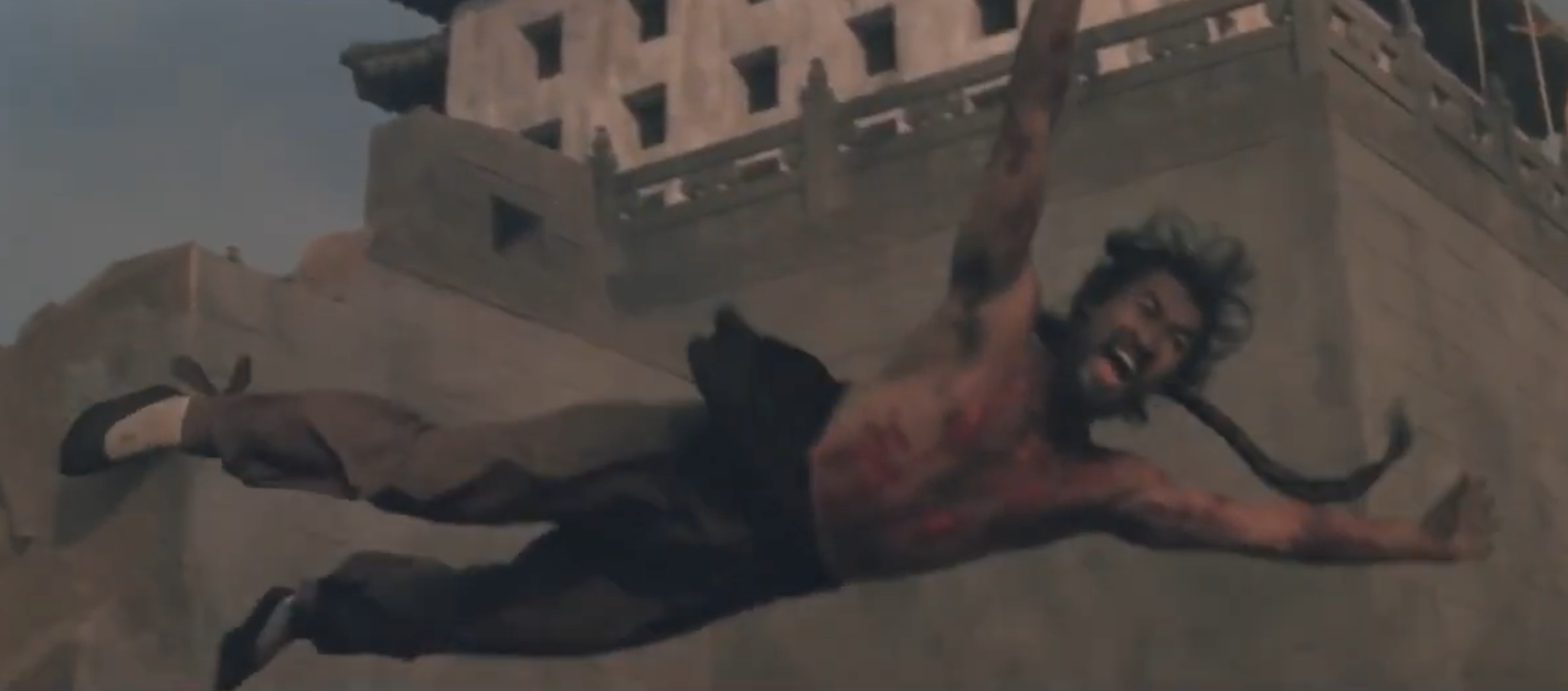
The group moves forward, using entrenchments (and each other) to evade bullets (many aren’t lucky). As they get close, their numbers are picked off. Once they reach a certain point, the guns fire causing the group to duck in their trench while the Japanese arm themselves with bayonets on their rifles. Chang makes a desperate roll as he sneaks towards the gatlin gun’s small building and flies up to receive GUN TO STOMACH. As he’s flying in the air with the sun beaming on him like some heavenly figure, the gatlin gun, which somehow manages to aim UPWARD, pierces the front of his stomach. Chang lands perched on the opening as he uses his stomach to block the continuously firing gatlin gun and wrestle with its operators. The bullets fly out from his back now (including his right butt check…go explain the physics there) and he dislodges the gun and uses the heavy machine to strangle the two operators to death.
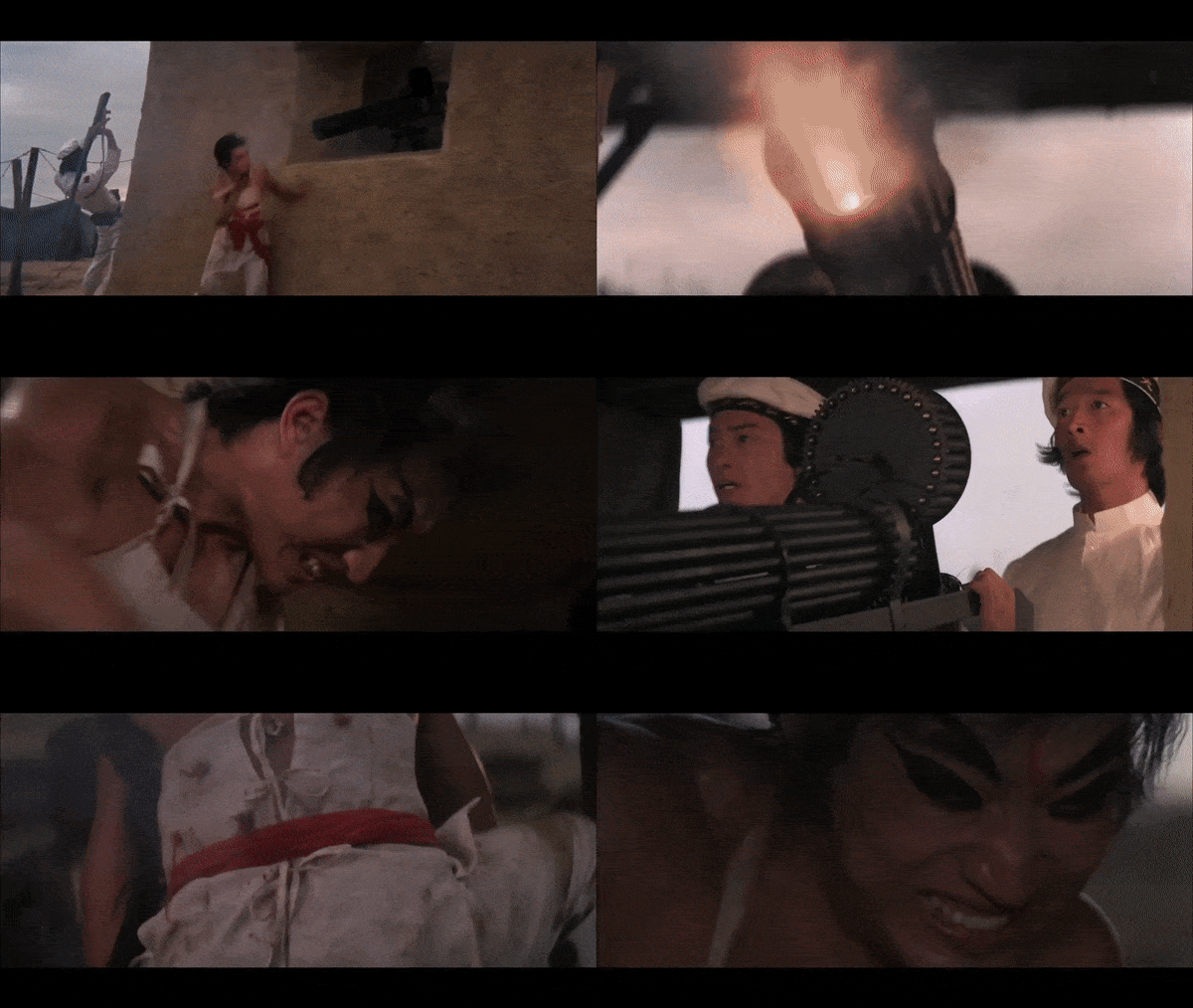
A hush falls over the camp as everyone is stunned by the insanity of the scene (because it was ludicrous). Several Japanese soldiers enter to examine the aftermath of their fallen comrades with Chang in a frozen death pose above the two dead soldiers then knock him over. At the same time, the distraction allows the surviving group to penetrate the camp and retaliate. The small group manages a tiny bit of revenge but reinforcements arrive from the Japanese army and they retreat. The Japanese captain though gets a moment to inspect Chang and thinks that the feat was impossible as we get a signature Chang Cheh up close shot of Chang’s death face expression.
The three and the surviving Boxers escape but encounter more Japanese soldiers. The Boxers are massacred mercilessly and the three counterattack. They manage to take down those soldiers with hand-to-hand combat before hiding in the bush and mourning the loss of Chang. In particular, Chen is the most affected as he realizes the loss was heavy. While that occurs, the nefarious Li Jung finds the dead bodies of some Japanese soldiers. In turn, some Boxers meet with him and he lies on how he was responsible for their death. The Boxers celebrate, dumbly believing Li Jung’s story. As news spreads around the country side of this “victory”, the tale becomes more outrageous like the Aesop’s tale about the birds that carried a message around the world, only for the message to become some perversion of the original story. By the time news reaches the empress’ ears, the numbers have become grossly exaggerated and included high ranking officials. Of course, the empress by this story (the mind hears what it wants to hear) and she doesn’t do anything to verify this information. On the other hand, the three true heroes drink tea and see a contingent meet up with them but they realize that Li Jung’s story has become outrageous especially when they were the ones responsible for handling the killings.
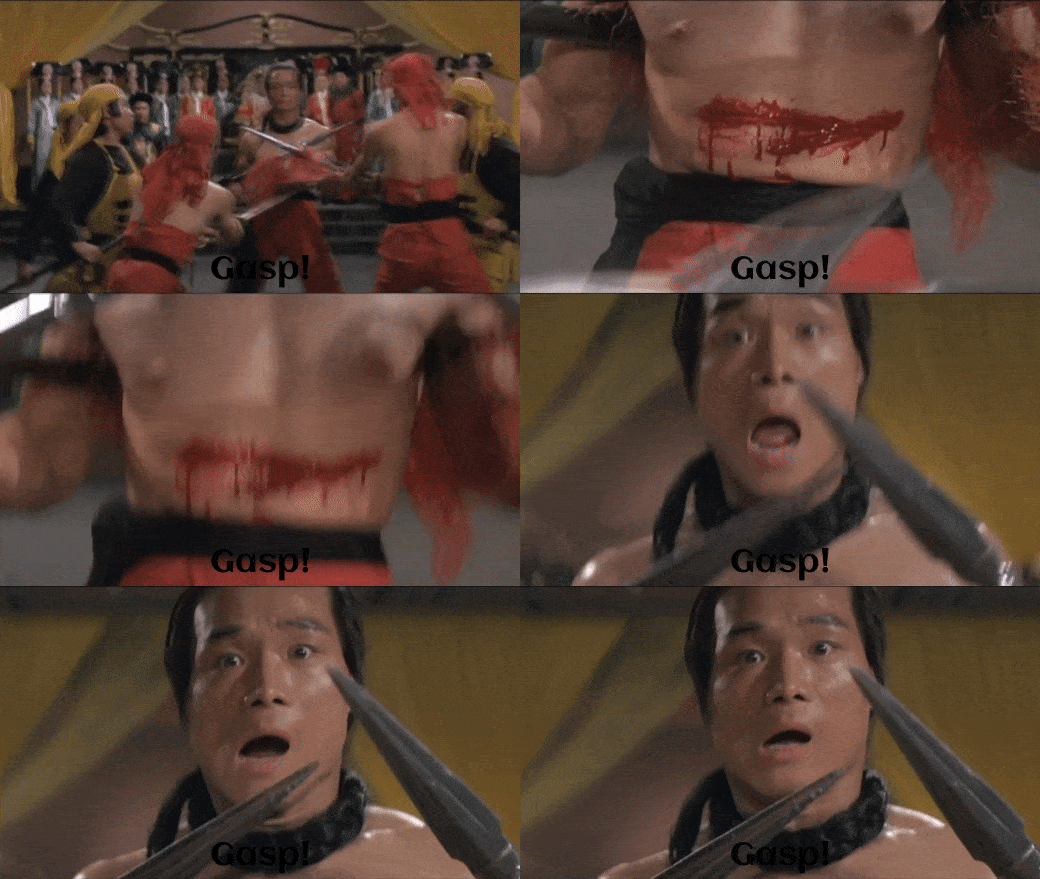
Instead, a demonstration is setup for the empress where the four are taken to show off their kung fu. The empress makes a slightly lewd comment about their handsome appearance (dirty old woman!) while her advisors attempt to excuse the Boxers of their manners. Two additional red shirts are brought as guinea pigs for Li Jung’s machinations, including a young Philip Kwok, who does some flippy fake kung fu shit then gets some swords to the stomach. The empress can’t see that he’s dying and the Boxers take him outside to die. Then to show the effectiveness of this kung fu (or lack thereof) to the empress, another random job guy is brought out to do another flippy shit where the Boxers shoot him. His back is shot up and he bleeds but the Boxers come out to hide him slowly dying on his feet. Shuai and Tsang want to help but Li Jung warns him about the two jobbers’ sacrifice. It’s enough to impress the empress though to have her take more action against the foreigners.
The city goes into chaos as the empress instructs her advisors to have the Boxers attempt to take back the Legation Quarter. The Boxers first assault any business that may seem aligned with foreign institutes but end up taking money and bringing it back to Li Jung. The empress finds the chaos to be a positive sign and encourages more.
At this point, the story again diverges between the Chinese version and the non-Chinese one. The Chinese one spends more effort on developing the subplot of Master Cai, played by Hu Chin, and the General Waldersee, played by Richard Harrison. Master Cai apparently had a relationship with both General Waldersee and currently Shuai. She understands that this group is in trouble and wants to help them. General Waldersee though, I believe, is one of the key heads for the German army and he along with some others plan to quell the uprising in the streets. That part of the story still is in the non-Chinese version. However, the Chinese version introduces us to Tsang’s girlfriend Xiao Jiu, played by Fu Sheng’s actual wife/girlfriend Jenny Tseng.
During the chaos in the streets though, Shuai goes off momentarily, leaving Tsang and Chen to hide and fend for themselves. Chen becomes impatient and decides to help his Boxer brothers. Tsang tries to stop Chen but can’t. Chen rounds up a small force of Boxers to defend the city’s wall as the Japanese invaders march in. Despite being outnumbered and outclasses in almost every way possible, Chen encourages his men to stand up for their country, which emboldens them. A harrowing fight breaks out where Chen and his men are slaughtered mercilessly.
With the wall destroyed, the Boxers demoralized and the foreigners now in control of the city, the empress goes into retreat. She’s forced to disguise herself as a commoner, leaving behind her fantastic jewelry while her hand trembles as the explosions outside shake her palace. One of the advisors makes a comment about her safety where another repudiates him in saying how the gods look favorably upon the empress for whom she is. That forces the advisor to repeatedly slap himself for blasphemy. As the empress is escorted away, the palace goes into chaos where all decorum to thrown out the window and her servants now are focused to fend for themselves. Elsewhere, Boxers are rounded up and beheaded, including one sycophant to Li Jung who cowardly pleads for his life.
When Shuai returns to find Tsang and Chen, Tsang admits that he couldn’t stop Chen. So it’s up to them. They try subterfuge to gain some revenge which leads to them building a reputation. Eventually, they encounter General Waldersee and have a fight where Shuai goes weaponless against Waldersee’s sword. They defeat Waldersee and spare him. The Chinese version also has Master Cai provide him with info but the embarrassment leads Waldersee to put up a bounty for the two. Tsang and Shuai go undercover and decide that they need to escape the city. Shuai goes out first and manages to beat back a small force setup near the destroyed section of the wall.
Tsang though tries to escape with Xiao but encounter Japanese troops. He does his best to defend them and the Japanese captain returns, wanting Tsang alive (probably for the bounty and for pride). At first, Tsang plays around with the troops but the fight gets serious when he finally uses one of the guns to kill a solider. At that point, the captain realizes that Tsang means business and shows no mercy. While Tsang battles the Japanese soldiers, our old friend Li Jung tries to escape. Some disguised Boxers ambush him but he kills them all before encountering Shuai. Knowing that Shuai understands the truth, Li Jung have a battle where Li Jung pulls out a few tricks with a short sword, proving that he’s still fairly dangerous. Shuai does get cut but when Li Jung attempts to run off, Shuai kicks the blade through Li Jung’s back and kills the evil charlatan in a karmic manner before heading off to the sunset (presumably towards Taiwan where that one political writer is located).
On the other hand, Tsang gets shot and becomes much more serious as he goes into a one-on-one fight with the Japanese captain. He manages to thwart the captain but the Japanese soldiers go after Xiao and Tsang tries to fight them off. Both are shot with Xiao dying in his arms. Sadly, Tsang cradles his lover as the sneaky Japanese captain attempts to assault Tsang while he’s down. However, Tsang takes up arms and rather than using his kung fu, he shoots the captain multiple times, standing up and planting himself over his dead lover. Other foreigners show up and witness the bloodied Tsang as defending his lover and they all lower their hats in respect (at least the American soldiers do). In the meantime, Shuai continues with heroic music to not leave the movie on as somber of a note.
So when I first saw this movie, it was quite emotional as I had known Fu Sheng and Chi Kuan-Chun from my other favorite Shaw Brothers production, Five Masters of Death. The general tone of this movie was quite tragic and at that time, I wasn’t as cognizant of my ethnicity as I am now especially when it comes to cultural and national politics. But when you see this movie especially back in the day, it’s pretty unforgettable. I think the tragedy aspect plays a huge part.
On the other hand, watching this movie with more contemporary/critical eyes, you see various flaws in certain aspects. I think the best way to describe my general sentiment is from a quote by my friend who once stated, “Chang Cheh does NOT know how to do modern films.” The Boxer Rebellion, while being a period piece, does have certain wild moments like Chang flying down and trying to absorb a FUCKING GATLIN GUN TO THE STOMACH. I know I’m not the only person who thought that scene was ridiculous as I’ve read others laughing in recalling that particular moment. Also, I think when Chen throws himself into the air with the Japanese blasting him in a freeze frame, it’s very humorous in a similar vein.
Also, despite how this movie is meant to be an epic period piece with tons of extras, the use of more modern weaponry and the larger scale outside, I still think it acts as a semi low key propaganda piece. It really casts the Japanese in a horrible light where they’re shown as merciless, unthinking, fodder for the heroes to beat up. And while I’m sure the actual atrocities are true (the black and white photos seem legitimate ones used), none of these people get any character development nor have anything redeemable about them.
On the other hand, there is a nationalistic type of vibe going on here especially with the revitalize China book. I think the Chinese probably view the Empress Dowager as being incompetent especially as the Qing dynasty was ending. So the movie isn’t just about China vs the foreigners or particularly the Japanese but it tries to take an inward glance at some of the elements that allowed that situation to happen. The odd man out to me was Li Jung though because he seemed like a charlatan that found his money mark and trick pony to get his share of the glory.
The Chinese version for me at least is something I don’t care for as much just because of the pacing. It’s longer and focuses more on some of the subplots. I do enjoy the costumes from the court though as those were quite elaborate. That is one aspect that I think the Shaw Brothers studio had done well where they could manufacture parts of China’s history in visuals.
At any rate, this is certainly one of Chang Cheh’s more memorable works. The kung fu itself really wasn’t remarkable compared to other movies where it was a bigger focus. I think it does provide a good blend of action, visuals, some history and decent characters who are approachable.
test comment
follow up test