
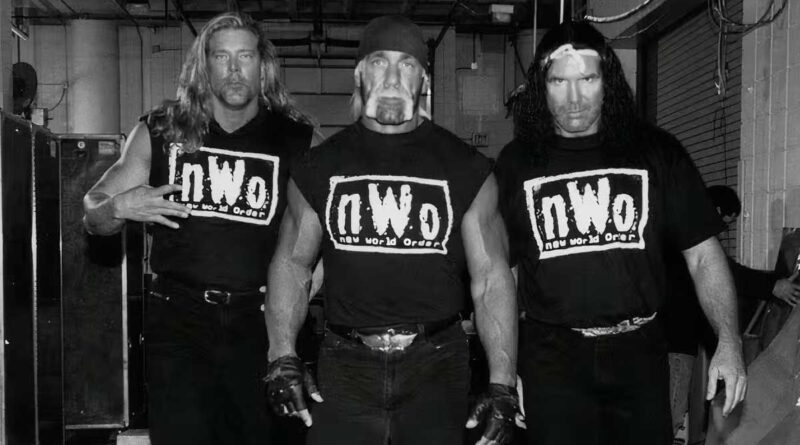
Eric Bischoff Reveals Original Plan for Splitting NWO from WCW and My Response
On his podcast 83 Weeks, Eric Bischoff talked about the original idea of splitting the NWO from WCW and what ended up happening. It’s an interesting inside take on that period if you were a fan of that period like I was and wondered what occurred and more importantly why. There were a few things he mentioned that made me scratch my head too and I wanted to offer my take on a few of those ideas. Note, I am going to use quotes from the 411mania wrestling post to contextualize my post better.
The main point with the NWO split was to finish up with Hogan and Sting, which to me was probably the best thing WCW had ever produced business-wise. From there, he wanted to use the situation to move forward towards another major conflict between two wrestlers (possibly Sting or Hogan and someone else) or two groups. Ignoring the unremarkable title run and match Sting had (both times with Hogan), it’s obvious that the direction would eventually point to Bill Goldberg and Hogan. I think Sting wasn’t the same guy we saw back in ’89 – ’92 where he was energetic, exciting, loud and could rally the fans. However, Goldberg was and he had the explosiveness that could’ve carried WCW for a few more years if the stupid shock stick incident never happened.
As for the split, Bischoff apparently did not want the separate NWO faction to happen originally. I think most people who were watching could agree that at a certain point the NWO got flooded by lesser talent that diluted the group’s star power. And once the Red & Black NWO faction formed, the group had played its course much like a series digging for anything to keep relevant but continuing to use the brand because it sold well. For myself, I think I lost a lot of interest around that point in the American products until The Radicalz jumped ship to the WWF and WCW tanked but part of the issue was the repetitiveness of WCW. This was even before Vince Russo got the book so it wasn’t just his issue.
The next part is where things get muddy but is quite interesting in terms of the politics inside of the company and the upcoming AOL-Time Warner merger:
Somewhere along the line, I got a phone call from Harvey Schiller, who said he’d just gotten off the phone with Ted Turner, and Ted wanted Thursday night TBS to have its own show, just like TNT did. So I was told I had to come up with another two-hour program in prime time at the same level as Nitro. At the time, it’s like, what do I do? Oh, I know — I’ll give the NWO the Nitro show, I’ll give WCW the Thursday-night show, and we’ll have our own intercompany rivalries, no different than Raw and SmackDown. It’s the brand-extension idea, really. The crossover, the drafts, all that nonsense makes a little internet chatter, but there’s no real money in it. That was the original plan, which was partially the reason the NWO started to get bigger without it making a ton of sense, because we were building up to whenever Thunder debuted — it must have been ’98 somewhere in there — partially so we could eventually do the split.
My first instinct about hearing this talk between Harvey Schiller and Ted Turner is that possibly Harvey was not acting in the best interest of WCW here and could have been lying. It just stinks of someone trying to manipulate someone else then later getting credit if their idea takes off. Obviously, I wasn’t there and I don’t know Harvey but I think Eric should’ve gone directly to Ted Turner to affirm this part himself because it’s a pretty big deal to come up with a totally new show and I don’t know if he was prepared. If that isn’t the case, then I’d have to think Eric was lying and trying to blame Harvey for the show. Either way, this isn’t something trivial one just pulls out of a hat.
That said, I never understood why Thunder needed to exist. WCW already had at least three other shows, three of which were on Saturdays with one on TBS. Why couldn’t they have just improve WCW Saturday Night or moved the time slot rather than add another show with less emphasis (i.e. the B-Team show)? I think having yet another show simply spread themselves out even more.
As for the NWO increasing in size “without it making a ton of sense,” too much of the situation seemed ill planned or not planned at all. A few key moments that happened that were poorly conceived to me were:
- Roddy Piper revealing Eric Bischoff as the “insider” – I know Bischoff admits that he mostly did this move to get off announcing duties. But the biggest hole in the logic here was that Kevin Nash and Scott Hall bullied him up until The Great American Bash ’96 incident where it culminated in Nash powerbombing Eric Bischoff through a table. Why would anyone take a powerbomb through a table from their “enemy” then suddenly side with them? Why would Eric Bischoff turn heel and become this insider? I think if they spent some time explaining how he actually was a weasel and had been trying to kill off the dead weight of the NWA by getting the WWF’s tossed out talent, then this entire plan would make a lot of sense. But you needed that part to connect the two moments together in giving Eric Bischoff a motivation for any of this. Not to mention, how would Roddy Piper have known Bischoff’s actual intentions? Just too much missing logic.
- The NWO Nitro TV Takeover Incident – One of the worst moments in pro-wrestling TV because the NWO had finally done what they said they were going to do: take over WCW (well their TV at least). However, whoever came up with this idea of a live re-construction of a set probably never understood how it would be executed and appear on live TV. Watching the audience just sit around bored was just as painful for being at home while this abysmal mistake went on. Then they had these “matches” where it was just the NWO messing around with some jobbers or talent that they could ridicule to sound cool. Who wants to see that? I think this situation was “encouraged” to happen because of the positive response whenever Nash and Hall showed up to do commentary as well as leading up to the original Souled Out PPV, which was supposed to be for the NWO. But this single night was so bad I think they had to re-think everything while the first Souled Out ’97 was mostly a disaster except for that Syxx vs Eddie Guerrero which was decent.
- The NWO “We’re taking over!” slogan. Take over what? I never understood the need for the NWO taking over. This is where pro-wrestling logic needs to exist because once you start going into a fictitious realm where almost anything can happen that no longer resembles a sport, the facade dies horribly and why you see what we’re watching today. When Scott Hall and Kevin Nash initially appeared, it was very exciting because fans believed that the WWF was going to have a real invasion, an idea Bischoff admits he stole from stuff in Japan (e.g. NJPW vs the UWF). The problem is that the WWF was never going to let him get away with this and a lawsuit pretty much killed the kayfabe identities of Hall/Nash (as Razor/Diesel). So they pivoted. Luckily, in getting Hogan to agree to turn heel, which was something many fans who hated Hogan in WCW wanted, the situation worked. There were two particular Nitros that got major ratings because of a full force NWO attack that was exciting and made for great TV.
The problem in the “We’re taking over” idea is that it’s still just pro-wrestling at some point. You have a match, try to settle differences, move up the ranks and win titles. Once you move beyond those boundaries too radically, it becomes impossible to take the idea of pro-wrestling seriously. So if the NWO successfully had taken over (which they did at one point), what can they do? You have a main title and you need to compete for that. You need to fill up an arena so you have to put on compelling matches that entice people to watch. But if you take over and it’s just your people in endless squash matches for no good reason, then you get WWF weekend TV that had been mostly bland since the 80s (except for the promos and occasional angle) Why would anyone want to watch that crap? If you’re taking over because you’re airing your grievances for being pushed aside or considered too old so that you can challenge for the top titles and get the top matches, then it makes more sense because you then can demand things in a more explicit, on-air type of creative control contract agreement that adds more logic to this.
- NWO Souled Out ’97 – Before I bash this PPV, let me say that the ’98 PPV was miles better and even did a decent buyrate from what I can recall. But Souled Out ’97 was a new PPV that had a different concept where the NWO were going to call the shots. The NWO were trying to have the star power and get most of Hogan’s buddies into the faction. Maybe Syxx was the best worker at that time in the entire faction, which is why he won the cruiserweight belt from Dean Malenko. But the matches here made it obvious that the NWO faction did not have the actual talent depth, especially as the cruiserweight division was kicking it up a notch and driving the more modern style up while the WCW main event scene had been faltering with Hogan and other older people maintaining their spots but not delivering on great matches.
The other major issue here was that having a PPV like this made no sense still because people on the NWO side lost. It sounds odd but if you’re booking your own PPV and you want some sort of logic, why would you have any credible opponents? Why not fill out the PPV with job people? Again, this is where the whole “we’re taking over” statement makes zero sense in the scheme of things. Again, I have to emphasize that a PPV could only work if the motivation of the NWO was to ensure that the people involved would be constantly given top talent and the most money. Otherwise, why take over a company in the first place? Why not just grab the titles and hold them hostage?
But as you can see just some simple ideas here with logic added demonstrates the fallacy for the NWO, regardless of their popularity.
The last key part of the interview has Eric Bischoff talking about what went wrong:
Things started getting ugly during the merger. Ted says, ‘Eric, go do this.’ I say, ‘We don’t have it in the budget.’ My boss says, ‘Doesn’t matter, find a way.’ Okay, that’s my job, go find a way. I found a way to produce the show, but the biggest challenge was that I had to bring in new talent — I had to bring in Bret Hart — otherwise I’d be looting my talent pool, filling four hours of prime-time wrestling with the same basically eight guys who drive things. So I started hiring more talent at the same time Turner corporate was slashing my budgets — pre-approved budgets, budgets that had been approved a year in advance — even though I was creating more revenue than I was projected to. They kept cutting production budgets, travel budgets, advertising, marketing — all being crushed because they were trying to manage their EBITDA, their earnings before interest, depreciation, and amortization, which was a big formula during the merger for executives who owned stock options to cash out big. So my company was being gutted while I was being asked to produce a new prime-time show with the same level of production as TNT. It was a crossroads of bad traffic.
The biggest red flag to me from this quote is where Eric Bischoff talks about bringing in “new talent” like Bret Hart. He goes on to justify these additions because of how he would otherwise “be looting” his own talent pool and filling in four hours of prime-time wrestling. Before I talk about the budget aspect, the big problem I have here is that Bischoff had a HUGE pool of talent at WCW’s height. Even if the main event people weren’t at the level of say HBK or Steve Austin in comparison, many were huge names like Luger, Sting, Flair, etc. And they still had a few people that were coming up the ranks like DDP and Bill Goldberg. From what I recall, I heard that at some point WCW might’ve had 200+ people on their roster. How can you say you didn’t have enough talent?
The problem to me was lacking focus and relying on certain people. Outside of DDP and Bill Goldberg, WCW really hadn’t created any new stars in the mid to late 90s. The cruiserweight division as a whole managed to get over and guys like Chris Jericho, Benoit, Mysterio and Eddie Guerrero were on their way up, but they had a ceiling (which is partly why they went to the WWF) Then there was a reasonable middle card that could do well like Jeff Jarrett, Curt Hennig, Steve Regal, Raven, etc. that weren’t cruiserweights but could have been built up towards main event status. If there was one major complaint about WCW in general under Bischoff at that time, it was that there were almost no new stars and he used Turner’s deep pockets to poach the WWF’s big talent rather than developing programs that could get their internal people over.
The last point Bischoff makes is a red herring to me about why things failed under him. He mostly blames the Time Warner-AOL Merger with their budget slashing as the key failure. If that were the case, why not cut a huge chunk of that 200 person or so roster? It was common knowledge back then that certain people were making huge money but not really pulling their weight. Worse yet others had special contracts, allowing them to sit home and collect a massive paycheck. You can’t tell me that you needed to go out and find talent when you already had existing talent that could’ve been used for another 2 hour show.
Also, even if WCW didn’t have great booking nor storylines outside of the NWO, they could’ve easily filled up part of the time slots with longer matches. Like it or not, that’s the WWE’s current strategy where they focus on a few talent having longer matches to minimize injuries while their main event people handle lengthy promos. If Thunder didn’t use the NWO at all and became a pure WCW talent spot, they still would’ve had great top end people like Ric Flair, DDP, Arn Anderson, etc. to handle the promo/star duty while the undercard could be filled in. I don’t see what the real complaint was here.
At any rate, obviously I wasn’t working at WCW at the time and can only see things as an outsider (not The Outsiders) so I don’t understand the complexities of the internal politics at WCW and AOL-Time Warner at the time. However, it is frustrating to see how things evolved in retrospective. I do think most people watching around that time shared similar viewpoints at least in terms of the sheer depth of the talent roster, the lack of usage of many people and the excessive expenditure of money on numerous wrestlers for no gain. And I think many people who were fans at the time, probably could’ve booked a reasonable show and would’ve advised against some of these bad moves pulled with the NWO.