Recent Issues AI and My Reaction/Responses
Besides politics, AI is probably the second hottest topic in various headlines to the point where it has become political and controversial even touching religion as the Pope himself has made a statement on the subject. As someone who has been involved in technology and computing for nearly my entire life, the idea of artificial intelligence is almost second nature to me as pop culture already had indoctrinated me into thinking that AI would become the norm with robots, talking computers, automation, etc. in addition to being a computer gaming nerd since the days of the Atari 2600. However, unlike almost every period of a tech boom, AI itself has become a split subject where people are quickly taking sides. While the idea of AI itself has been around for numerous years, only in the last 2-3 has it gotten to the level where you see hysterics both in terms of its pundits and the naysayers who are almost the equivalent of contemporary Luddites. I think as someone who has been involved in technology both as a heavy user and someone who produces it as well as one with a background in humanities, I want to explore these topics, some of the people making bold statements and try to address the concerns and issues that are evolving.
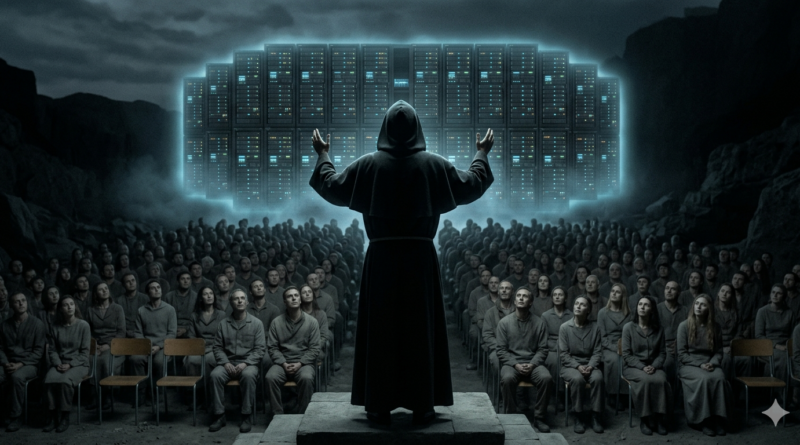
The Pope’s “Magnifica Humanitas” (or “Magnificent Humanity”)
This doctrine was a long piece that pushed the idea of the AI race as a contemporary “moral crisis”. Here are some of the main points:
- Human-Centric Limits & Dehumanization
- The Pope emphasizes that while AI can simulate language, reasoning, and creativity, it lacks a conscience, empathy, and spiritual depth. Therefore, critical decisions impacting human dignity cannot be outsourced to algorithms.
- He cautions against reducing the mystery of the human person to mere data points, performance metrics, or algorithmic profiling, warning against a culture that treats people as commodities.
- Disarming AI & Autonomous Warfare
- An Outdated “Just War” Theory: In one of the document’s most significant shifts, the Pope declares the Church’s traditional “just war” criteria outdated due to advanced technology.
- He states it is “not permissible” to entrust irreversible, life-or-death military decisions to AI. He explicitly calls for AI to be “disarmed” and stripped of logic that turns it into an instrument of domination, exclusion, and remote warfare.
- Labor Protections & The Hidden Workforce
- The document strongly criticizes corporate efficiency and profit motives that justify mass layoffs.
- The Pope calls out the hidden exploitation of vulnerable workers worldwide who are underpaid to clean data, tag content, and train these massive models under algorithmic surveillance. He insists that any deployment of automation must be accompanied by robust worker retraining and employment protections.
- Concentrated Power & Regulatory Frameworks
- Leo XIV warns that leaving AI development solely in the hands of a few tech conglomerates or dominant nations risks creating a dangerous monopoly on power and surveillance.
- He rejects voluntary corporate ethics as insufficient. The encyclical demands robust legal frameworks, independent international oversight, absolute transparency in automated decision-making, and proactive government regulation.
- Truth, Disinformation, & Infrastructure
- The Pope highlights the threat of deepfakes and synthetic media, noting that democratic life and societal trust rely heavily on a shared basis of truth and responsible journalism.
- Shifting away from pure philosophy, the doctrine explicitly critiques the heavy ecological toll—notably the massive energy, water, and land resources required to build and sustain sprawling AI data centers.
Before I move onto the next point, since there are quite a few key ideas here, I want to address them each. First, I don’t disagree about the idea of AI currently lacking the human attributes that the Pope enumerated. Perhaps, the biggest, missing one is that AI, as far as we know, does not possess the animal instinct of survival. More than anything, that factor is a major driving force behind how true living beings behave. However, I would argue because AI does not possess this quality, it also won’t act in the same irrational manner as a living creature.
One could argue that the notion of allowing human types of decisions in the power of AI is dangerous. However, the Pope also fails to address humanity’s own abysmal history when it comes to its treatment of each other where the church and religion themselves can be directly attributed to a huge amount of this problem. While I do understand the intent behind his words, there is a level of hypocrisy in treating this situation in a one sided manner without tackling existing issues.
Regarding the “entrusting irreversible, life-or-death military decisions to AI,” I would also say that most humans should’ve be given this ability either given the current landscape of psychotic world leaders, politicians, military generals, etc. I think this statement is merely fear mongering that is subliminally attached to movies like The Terminator, which has put the idea of AI in a negative light. The reality to me is that such a thing will not occur (e.g. giving The Machine the proverbial red button) because you have a bunch of control freaks in charge who are the ones wanting to be responsible for pushing the button themselves. If you really want to avoid this scenario, the only method is complete disarmament. But you’d need some sort of future Star Trek type of global government to enforce a more idealistic and progressive society.
Next let’s address the idea of corporate efficiency and profit motivation that justify mass layoffs. The best thing that could happen here is if government heavily penalized the top most layers of companies who are responsible for the direction and sign offs. If, for instance, a CEO and CFO (as defined per SOX) were to sign a mass layoff in a company that has over a certain number (let’s say 50 or more), especially if that company is public, then those people ought to either take a full pay cut, not be entitled to any monetary remuneration and/or also be fired since they failed to drive the company in a manner that permitted the simultaneous alteration in direction (i.e. adapting AI). In short, make the golden parachute and company bonus illegal with the penalty of firing, a restriction from participating in other major companies and/or jail time. Then give protections to employees where a mass layoff can only occur when its proven that the company is losing an extraneous amount of money and cannot survive with documented proof that is auditable by at least 2-3 third parties to ensure the compliance.
Now, he also goes onto mention the “robust worker retraining and employment protections” from these situations where employees are discarded. I would almost agree except that these types of jobs are mostly manual. So what’s going to happen? One crap job to another? The whole idea of technology ought to be that we increase human efficiency so we can do the things we want. Retraining is a code word for an alternate shitty job. So you’re not really solving problems here because there’s a fundamentally bigger problem in all of this that goes beyond technology itself being ignored.
From there, there’s the idea of “a few tech conglomerates” and/or dominant nations that will see the rise of monopolies. A long time ago I had written that social media platforms like Twitter and Facebook should be public utilities and free to use. I still stand by this idea but I do think he isn’t incorrect in the idea of these dangerous monopolies that are being created behind certain countries. However, the bigger problem is the allowance of the global economy and multinational corporations. I think the pandemic as well as the Ukraine-Russian war clearly demonstrated the fragility of the supply chain line as well as the dangers of having satellite offices in foreign countries.
To me the issue isn’t so much how a country can have dominance but how there needs to be imposed a limit to growth on companies. In the past, this idea was called a monopoly but deregulation has prevented better enforcement. In addition, I’m not in favor of multinational corporations. I think it’s a difficult problem. I do think that companies could license themselves outside of their country but strict international regulations should better dictate the local company operates and shares knowledge with the parent company.
At the same time, I think regulation is a very touchy subject. Part of the reason technology has been able to evolve in this manner since I’ve come aboard is that it’s not well regulated. I think innovation requires cowboys and green pasture. For instance, without Napster, you wouldn’t have seen the push for the digitization of entertainment with streaming to a degree because the executives for media didn’t believe in computing nor the idea of watching on computers or like systems.
Where the real issues have evolved is the insane amount of wealth being generated and left to only a select few. Unfortunately, regulation in that area has been severely weak because the people who ought to be governing that system are the same ones invested in it (literally the investors) where they only allow a small group into their exclusive club. But this isn’t necessarily an AI problem nor even a technology problem. It’s a human greed issue, which the Pope, being a godly man one supposes, should have correctly pointed out is a sin.
Finally, the Pope addresses (or signs off on) the idea of synthetic media regarding ideas like deepfakes and social trust issues where AI helps generate disinformation. Also, he tlaks about the ecological aspects. In the social trust part, again is the issue really about AI here or how people are just that gullible (i.e. stupid) where they easily believe what they see and hear? My saying is that “the mind hears what it wants to hear.” So most of these people are already predisposed to these issues. Oddly, the church itself has historically been involved in mass brainwashing and creating cult-like hiveminds by removing people’s critical thinking is misplacing people’s values into blind faith. I think for the Pope to be credible in this he would have to simply admit that God does not exist and that religion has been a fraud, which he won’t do.
As for the ecological issues, while this is true, what are the alternatives? Do you think society’s demand for information will suddenly halt? People are impatient and want information NOW. So these data centers are just an artifact attempting to fulfill a certain demand. Do you want people to go back to Dixie cups and string? Or how about the equally ecological unfriendly use of trees for paper in recording everything? Innovation and technology have always been about trade offs. Yes, we need to be aware of the damage things are done but you can’t expect one solution and go back for another once people recall why we went towards a certain direction.
In general, while I see the Pope’s point here, I can’t help but think that there’s also a small underhanded agenda involved. It’s impossible for me to dismiss the church’s own potential conflict and desires to once again be part of the forefront here since AI effectively is part of the stage of human evolution. The problem I see is that the church itself is an archaic artifact that has managed to continue along in a leech-like existence. With all the historical hypocrisy and the problems that religion and the church have caused human history and continues to do, it’s impossible for me to accept what the Pope is saying without some level of skepticism.
Bernie Sanders’ 50% Public Ownership over American AI Companies
Let me preface this section by saying that I really respect Bernie Sanders. I think he would have made a far better candidate that Hilary Clinton in the 2016 election and probably could have been a two time elected president if he was given the opportunity. Also, I believe he generally is a very intelligent fellow, possibly too smart for the American public, which is why I think he partly got rejected (although I think it was more of the result of Clinton’s known name and association to Bill that elevated her into that spot). That said, Sanders’ proposition makes no sense to me, although the argument does have some level of merit.
Regardless, an article over at Tom’s Hardware notes a bill Sanders has introduced to force American AI firms to overturn half of their stock to the public. The high level idea is to create a 50% tax on the stock of those firms and will be “held” by the public through a “sovereign wealth fund.” In addition, this bill implies that the government would have a stake in these companies, which as a proxy would allow the public to supposedly act as a kind of shareholder.
The main quote from Bernie is,
The foundation of AI is our collective human intelligence. Our books, songs, artwork, journalism, computer code, scientific research, videos, conversations, images, and ideas spanning generations. As Sam Altman himself acknowledged, AI models were trained on our ‘collective experience, knowledge, and learning of humanity’,” said Sanders. He also added, “Since AI is built on the collective knowledge of humanity, the wealth it generated must benefit humanity. Not just Elon Musk, Jeff Bezos, Mark Zuckerberg, Larry Ellison, and other billionaires, or the venture capitalists and Wall Street firms who see AI as the next great wealth extracting machine.
Bernie also tries to connect how certain people involved with these AI companies have mentioned the idea of a public trust fund/universal income, citing Musk himself as one person apparently believes in this idea (whether he consistently believes in this idea is a different thing entirely).
While Bernie seems to target AI in this situation, I’m reading between the lines several things, mostly that the core issue is still about money and people. If we remove money from the equation, I think various aspects of these discussions on AI’s role will mostly go away. Right now, AI is being used as a tool by prominent people to push their own agendas. But I see the issue being that as a modern society, people continue to use currency/wealth as a means of exchange. Despite the fact that most people have come to accept the idea that “money is the root of all evil,” we, for whatever reason, don’t make any attempts to rid ourselves of it. You can’t say Bitcoin or that type of thing is a solution; it’s simply a different medium with another body of control.
The other major issue again boils down to this being a human issue. I am reminded of George Carlin’s comedy where he talks about environmentalism and how effectively it’s bullshit and a hypocrisy. His critique is that the Earth itself doesn’t really care about what humans do in effect (at least that we’re aware of). He points out how recycling and plastic are from the earth itself. The ones who do care are people and he mentions that environmentalism is a human concept where we’re the ones that will go away while the earth, solar system, galaxy and universe will continue once humans pass away from existence. So are these issues an AI problem or a human one where once again a select few privileged have been allowed to become the primary voices and controllers of these things?
I think that Sanders has good general intent but it’s masked by his inability to directly accuse those in power (Wallstreet, the CEOs/board members) that they are the ones causing this issue. I think in citing Musk, he attempts to ally himself with one of those who probably does not share his same sentiments, which to me is a political move and makes me wary of his views here. Again, while I respect the intent of the message, the underlying tone and way he’s framing things to me problematize what he wants. I don’t think a so-called public wealth fund would really solve any issue; instead, we need to push higher the ideas of greed and human selfishness as the real issues as well as accepting how these things have been created by people, not AI themselves.
Data Centers and People’s Resistance to Them and AI
Another interesting topic that has been popping up in recent weeks is the idea of how governments are rejecting the establishment of AI data centers in cities. For instance, Monterey Park recently voted in an overwhelming fashion the rejection of building data centers in the community. Seattle also is posed to do the same as one of the biggest cities, which is ironic considering it’s the home of Microsoft and Amazon. The main issues associated to the rise of data centers are the associated cost being passed down to the locals for energy consumption, the high usage of water, pollution/environmental unfriendliness and pushing people off the land. In addition to these problems, the cost of computing hardware have risen due to scarcity.
A good chunk of those affected are people living in rural areas as per an article at Gizmodo. They cite the various reasons above as this resistance along with rising temperatures (environmentalism). So I’m beginning to wonder if data center resistance is going to become the latest form of NIMBY-ism? While I don’t know what people in rural zones do, I do think the hunger for information consumption and convenience will not die down anytime soon. But as information technology continues to become a normalized part of life, the idea of data centers won’t go away anytime soon. I read how some places are even proposing (or doing) having data centers being placed in the ocean because of the natural cooling and accessibility to water.
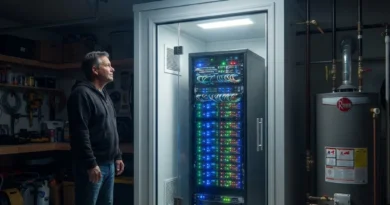
One thing I have not heard proposed is for companies to rent out people’s personal spaces to be used for running a portion of their data centers. Of course, that probably is an impractical idea because of security risks. However, I once wrote (maybe on my old blog) that I saw part of the future of home appliances being something like a network storage device kept in ones garage like a water heater. Having worked in a data centers myself, I understand how this massive storage units, built like an overpriced refrigerator, would be housed in a specific facility, connected by special optic cables and containing tons of write-once type of disks with multiple levels of redundancy. But we already have something like this these days in terms of hardware with personal network drives.
The one difference in my proposal is that part of the computing power would be done at ones home rather than a data center itself. I think that rather than having these massive data centers we will eventually see the rise of the personal home data center where companies like Meta, etc. outsource part of their software and people will run private networks with their own devices. I think if they did things in this manner, the cost will be appropriately given to the costumers based on their own usage. But it will become a personal responsibility much like how one chooses to run their AC all day during the summer in certain parts of the country during the summer. Maybe that would be the better solution than having another sprawling mass of space that only gets used by a select group.
Mass Layoffs with the Cost Shifting Towards AI
This is probably the most worrying situation more than anything else and the most relevant for people. I think the other issues would be more localized if the job market wasn’t as bad where the top layer and shareholders are protected while everyone underneath are negatively impacted. Part of the issue here though to me is that there are no harsh penalties against the decision makers while record profits are underscored and hailed by the shareholders. I still don’t consider this purely an AI issue but a human greed problem where you can nail the issue directly at the C-suite and board of investors.
While it is important to support the stakeholders in a company, I don’t think it should be at the expense of society. I think there needs to be a social responsibility attached to stakeholders to ensure that the company’s mission strictly isn’t about shareholder profits but that there’s a clear mission statement and something that positively impacts and uplifts society, which ought to be the reason for investing and participating in a company. This problem already existed before AI came into existence but it never has been addressed. I think before shifting the complete blame on AI, people need to put more focus on investors, shareholders and the C-suite level for adding more pressure to enforce real accountability and social responsibility with clear guidelines on what social responsibility ought to be (e.g. be a good person)
The Rise of Bot Traffic
This is an interesting issue that caught my attention this past year, especially as someone who runs this blog. But the CEO from Cloudflare has cited this issue. Recently, I started monitoring my traffic with more scrutiny as I have direct access to my server and can see my access logs in real time. But the one key thing is observing the flood of obvious bots. When I look at the various counters on my site, I have to wonder which ones are real vs a scraper and/or bot traffic. Last month, I even saw a bizarre spike in traffic over a small period as a result of getting hit by something in Singapore. I have no idea why but after changing the design, my traffic did decline significantly.
The one interesting thing to note about this type of traffic is how a bot acts as a type of agent on behalf of someone or something else. In my case, I have no idea what the bots are doing outside of possibly trying to learn as I do not currently enforce anti-bot ban (through Cloudflare) as I haven’t seen anything particularly harmful just yet. Also, I don’t know what to do about this traffic at this stage but it is worth mentioning as the site’s owner.
Big tech CEOs Connected to the Direction of AI
I think most of the tech CEOs in being the ones that are apparently driving the direction of AI might be slightly misleading in itself. I do think that their primary job is acting as a sales person, the face of their company and thus having the implied agenda of going all-in on the idea of AI. However, I tend to dismiss Big Tech CEO types mostly because to me it’s always been about the Cult of Personality (sings Living Colour) rather than people who are probably implementing this stuff directly. And for me this is a critical distinction because these people mostly are dealing with the sign offs and collecting big checks. But it doesn’t mean that they’re directly in control of every tiny detail.
But I think the real story is that these people should have more accountability in the aftermath for what’s going on with AI. There’s nothing being done to force the hand of these CEOs and their shareholders from pushing forward with their agendas. That said, my ultimate appraisal of these people are that they’re mostly filled with hot air and their only contributions to society at this point is carbon monoxide/methane. Maybe we should examine that aspect instead of the data center emission problem more closely.
Students and Cheating
There were some articles talking about the rise of cheating with AI in classes. One university proposed the return of the SAT system because of abysmal math abilities while another professor at UC Berkeley remonstrated the increase of cheating. However, sometimes I have to question these things. The SAT tests to me were always a load of shit because they didn’t really test you for what you knew. Back in my day, they would joke that the SAT was used to test if you can take a test. But they only tested you on specific types of math and English problems. Worse yet companies like Kaplan made money by offering courses, which aren’t anything better than the l33tcode type of institutions that seem to pervade companies’ tech interview processes.
As for cheating for a class, I have to wonder how it’s being done. Unsurprisingly, cheating has been a thing forever. So what exactly is the difference these days? Is it because the tests or assignments are unfair and don’t really demonstrate what a person learns? Is it that the way these institutions are constructed that they’re very skewed? I remember back in my humanities core course at UCI how one of my professors discussed how UCI (and maybe the UC system at large) was based on a German system. Since he was teaching history on the Nazi’s, it made me believe that some of the foundational aspects for these institutions have a darker past that has been hidden. In addition, how often do you hear after a person graduates or even takes a mandatory class that they would say, “I didn’t learn anything useful.” Why is it that some of our most successful people have been drop outs while the rest of us suckers end up with crippling debt and 4-5 years of our lives wasted?
I’m not saying cheating is good. But I think there’s a level of hypocrisy if you don’t examine the broader picture. Maybe the implication is that people are getting dumber here. At the same time, I think the university is becoming outdated in their methodologies. AI and tech are effectively fast tracking us as a people because it’s going to help augment our abilities. Why use outdated mechanisms if we can fast forward ourselves is the main concern I have here.
My General Thoughts
I have stated on numerous occasions that at the end of the day, I still consider AI a tool that can be used for good or evil or just neutral. But it is a tool and like any tools, how one uses it is a contextual matter. Because AI does not have a so-called conscious or soul or whatever, it’s impossible for me to place an unmitigated sense of animosity the way most people have been. I think AI is useful (such as helping me generate images or act as a coding assistant/sounding board).
Most of the issues I see here are strictly human problems. I think the real issue that no one wants to admit is that people don’t want to blame themselves for letting things evolve to this point. People want the convenience of computing and not having to deal with thinking and letting something else handle trivial matters. What those trivial matters are depends on the individual. It’s kinda like saying guns are the problem when a shooting occurs. The issue never is the gun itself but the person who pulls the trigger.
Beyond being a tool, I see AI as a result/effect of human laziness. The stuff the Pope talks about in terms of attempting to humanize the matter conveniently leaves out the issues of human’s inherent flaws, which is odd because most of them are actually described in the Bible (if you get rid of the mystic/archaic jargon and focus on the inherent messages). Both sides right now are equally problematic in dealing with AI and as per mankind’s usual behavior, each side is on extreme polar opposite sides.
But as someone who directly witnessed and participated in the Dot Com days, I still consider this situation just another extension of another form of human laziness and greed at its core. But back in the Dot Com era especially when Napster experienced a meteoric rise, a certain segment became quite vocal and protested because their livelihoods were threatened. Yet many of these people are the same ones who extensively use tech/social media to embolden themselves and increase their cult of personality behavior. So again it’s business as usual to me.
Instead, I propose something else: why not address the problems of human greed and laziness? Fess up to how money and these old institutions have created these fortifications of power. I have cited in the past Christopher Nolan’s Batman Begins where Ra’s al Ghul talks about how they invented economics as a new form of modern warfare. Given that movie was released in 2005, one can see with the Dot Com aftermath and recession where perhaps this idea was taken. But the fact that food and basic living have been politicized and weaponized against normal people where the ones benefiting are these white collared crooks and that the aftermath of Enron did not in fact correct a completely broken system means that society as a whole has failed because people either didn’t care enough or wanted to join the elite. So start there with Wallstreet, the CEOs and the ultra wealthy and fix the problems there before assaulting AI directly.