
The Inverse Problems of AI, Data Centers and Investment
A while back when I had my own self-coded blog, I wrote a post on the idea of something like a SAN/NAS home appliance. There have been smaller versions of this for the average consumer such as Apple’s Time Machine and Western Digital’s external drives that employs its own software for wider access. But my original concept was based on my experience when I worked in a data center in Tokyo over at Tsurumi. At the time, I got to partly work on these EMC SAN type of storage units that were about $1.2 million a piece at the time (where we had two for redundancy) that used fiber optics lines and were meant to handle issues like audits because of their write once type of system. Equities made the initial investment and part of their cost recovery plan was to “lease” it out to other cost centers (meaning other departments), even though most groups just saw it as being these expensive toys. Nonetheless, in learning about these devices, it influenced me as tech really started to take off for me and give me a variety of ideas about the future of computing.
I want to pin that blog anywhere between the years of 2003 – 2006 or so. But the idea was that with the rise of increased storage as a result of media (e.g. MP3s, video, phone cameras and even home surveillance), the problem I saw was portability, redundancy, standards, privacy and security. Already by being part of the Unix team at the bank, I was able to preview Sun’s N1 system, which was going to be their version of the cloud. Many of us scoffed at the idea, especially for a bank which has its own standards and requirements. Of course, Amazon and later Google, etc. developed their own cloud based systems which have become more or less the de facto standards for most web based systems these days. But I never truly trusted the idea of having my data on the cloud (as in the aforementioned file types).
In recent months, one of the biggest controversial tech items pushed to the forefront in terms of security has been Flock. Most people have never been comfortable about surveillance especially with privacy at stake. Ring was another that had its own set of issues but Flock was less personal in that these things would be setup by the company and the data shared with the authorities. And as things turn out, some of this data was not used in an ethical manner. At the same time, the CEO has put out ominous controversial statements about the sacrifice of privacy (without any form of compensation for the general public), which has made him somewhat an enemy of the people at the moment (which includes people publishing the CEO’s address on the net in a somewhat ironic statement). But this scenario highlights to me the problem of centralized, walled off data that is handled by corporations as opposed to the individual, the same fear and problems I viewed in my original blog two decades ago.
That doesn’t mean that the need for storage and processing of data is irrelevant though. I still view digitization of things as the way to go just because of the basic idea of removing the need for physical things outside of the storage and connectivity aspects. I know there’s this contemporary trend of going back to analog or other backwards type of things but it’s simply not reasonable in the scheme of things. I think even if society would move back to say CDs and VHS tapes, eventually people would return to digitization out of need. So the problem is going to remain despite the current sentiment.
The real problem that technology companies face more than anything is public trust. Even during the dot com era, it took a lot of effort for people to place their credit cards online. Since that time, with the explosion of social media and the gradual build up of these mega tech corps, people have lost faith in these empires because of issues such as the selling off of consumer data, data breaches, algorithmic manipulation of pricing/content, the erosion of rights, mass loss of jobs, etc. Much of the fears presented during the dot com era have manifested and worsened over time.
At this stage, we might be seeing the equivalent of a Luddism 2.0. The destruction of Flock cameras, the rejection of social media, the return to more physical goods, the protests of data centers, etc. are because of this general loss of trust in Big Tech. What’s even crazier (to me at least) is the state of AI which seems to defy the usual technological trend of mass acceptance but has been turning into disgrace by those not involved at the top of the decision making process.
And before I deep dive into my thesis of the title for this post, let me talk about AI itself in how it’s not simply a trend but a gradual evolution of human growth. That might seem like a bizarre statement but AI in reality is nothing more than another form of human laziness. Humans have to be one of the laziest creatures on this planet and their history demonstrates the need for effectively a slave class for the privileged few. Because of economics and how things have “modernized” in terms of social development, the idea of a specifically named slave class has been erased at least as a commonly used thing that may exist in a modern society (just the idea of slave/master read/writes in tech have vanished because of the implications). That doesn’t mean that the desire for hierarchical control has diminished nor how people effectively want to be like a Peter from Office Space. In that sense, the very idea of AI won’t go away because let’s face it, most of us don’t really want to think especially about things we need to do that we don’t want to do.
Given the setup for this post, I want to describe what I see as this inverse problem of data centers, AI and investment. These three things are tightly related and we can see how part of the motivator in the core problem centers around public trust. I think a huge issue in tech has stemmed from the stigma associated/created from the dot com bubble bursting. Since that time, Wallstreet and companies have been far more cautious and, in a way, smarter about how they “grow” corporate entities, which in all fairness, is actually a great thing.
However, I think Wallstreet has long lost its meaning as a result of what investment ought to be. I remember hearing about how electronic/algorithmic trading in conjunction with real time updates for news effectively upended Wallstreet behavior. If Wallstreet was already the symbol of ultra capitalistic greed, then those two elements pushed the line overboard.
We have to briefly talk about the dot com era to see where a lot of what I want to discuss is going. First, the amount of money spent vs how much it generated during that period was ridiculous. And you can say that there were a lot of bad actors involved with some very infamous instances like the company that spent over $10 million for a Christmas party. While that latter case turned out to be a sham run by a scam artist, it wasn’t uncommon to hear about those types of instance around that period of sheer hedonism and lavishness.
What followed was this grimness especially as 9-11 erupted and the country went into a recession. Eventually, new companies did emerge but it was only through the excitement of aspects like social media, web 2.0, Google, etc. and the new IPO regime that jumpstarted Wallstreet again. I think the problem there was that once people got the taste of the sweet addiction of wealth from the dot com period, it never went away.
But to ensure that this wealth would be maintained I think we started to see the tightening of the reigns. Obviously, Enron was another major problem that came around that period and the result was SOX where public companies and certain finance companies (like banks, securities, etc.) would need to fall under certain guidelines and their management (namely the CEOs and CFOs) would be held accountable. I personally think more of the fallout ended up becoming a bigger headache for the people working under this system where you increased the amount of bureaucracy. In some cases, this was warranted like the splitting of duties between production and development as a simple example. But did we really see anything come for the CEOs and CFOs thereafter?
Nonetheless, one thing that seemed more prevalent than ever was the ideas of quarterly revenue and this catering to shareholders. I think there was more scrutiny over finances because investors (reasonably so) did not want companies squandering money away and ensuring that they were properly spending it. That isn’t to say that companies didn’t still throw parties or have their hedonistic ways but at least from what I’ve seen they weren’t as lavish normally compared to the more infamous ones (except in cases where a company might have an outstanding growth period).
But I think a consequence of this change in scrutiny was increased pressure on performance that has led to a great deal of instability in the market. Since the dot com period, there’s always been a constant reminder about a recession generally aimed at tech. Usually with tech, I feel that its very nature makes it a harder sell for investing especially with web tech just because the barriers to entry are so low in the scheme of things. At the same time, because there’s no real guarantee that the tech is going to take off, there is a risk associated where these days you need some sort of vanity numbers before people take you seriously.
Then there’s the layoff problem that probably has created the number one concern for the market at large. The pattern has been when a quarter falls short of investors’ expectations, the quickest, dirtiest, easiest and laziest solution is to layoff. Because of that, you really lack stability and confidence especially long term growth prospects. Not to mention such a mentality breeds resentment not just with employees but the public.
Yet I think the end result of this situation is that investment in tech isn’t really about the tech itself but the ability to make money for these investors. There’s something really backwards on how that operates to me where investment should really mean putting money into something that deserves to grow because the idea, team, company, etc. are good and that the money generated is a natural consequence of something solid. And this is where I think the inverse part is causing chaos in the tech industry in the worst manner possible right now.
So how does this relate to data centers and AI? The thing with AI is that it’s a very vague idea. People have picked up the term and really pushed the idea heavily these past few years but I don’t think most people understand what it really is nor what it ought to be. Instead, AI seems to be entangled with LLMs for the most part, in particular the big names like OpenAI/ChatGPT, Anthropic/Claude, Google/Gemini, X/Grok, etc. Eventually, we started getting more tools and systems for managing agents like OpenClaw.
Yet the thing that has been said about Wallstreet is that there hasn’t been the “killer app” yet. Most of what has been show cased are these chat bots, “agents” for doing minor tasks, code generation (with varying degrees of success or failure even), image/video/audio generation and various other “mundane” type of tasks. Personally, I think this is just another instance of Wallstreet lacking any true understanding of tech and only looking at raw numbers.
But let’s circle back to the idea of data centers. The big thing about AI is the sheer processing power required to utilize it. I mentioned in a previous blog of my own limited experience with running Ollama on my coding machine. The idea there was that I needed to grab a model which contained a set of trained data and use the Ollama server/app to be deployed. The thing chugged hard on what was a very trivial question (present the cast of the movie Alien). After dealing with that situation, I learned quickly that you need pretty beefy hardware to even consider running such a thing.
So it’s obvious that for the current manner of AI succeeding it will require a great deal of computing power. The big issue now is that data centers have become a hot stakes topic in politics where you understandably get NIMBYism. In this case, the sentiment is warranted due to a number of factors:
- Space consumption
- Waste/byproducts
- Extreme usage of water
- Chip cost massive increase
- General hardware depletion on the market
- Backdoor deals with politicians
- Electrical cost that have been dumped onto local residents
- Potential (environmental) hazards
- Pushing people off their land
But there’s another potential problem that I don’t think anyone has identified: information redundancy. Because of the walled data garden problem where large companies are shrinking access to their data (at least without paying steep prices), we no longer have the super information highway but solitary fortresses. Yet we don’t know what exactly goes on behind the scenes. This is worrisome because we can’t tell how accurate the data is. In the case of the Ollama experiment I did, the output for Alien, which is an old but well known movie, provided several cases of bad data. Worse yet the answers to certain queries can vary, making the responses from these LLMs less reliable.
Yet is this scenario where you have competing market forces trying to outdo one another for dominance actually be the thing that is causing a worse scenario? When I read about these investments and Wallstreet in terms of where its placing its bets, it feels like they’re fueling this competition but not caring about the actual consequences as long as a few (bad) actors win. This is flat out wrong and ass backwards.
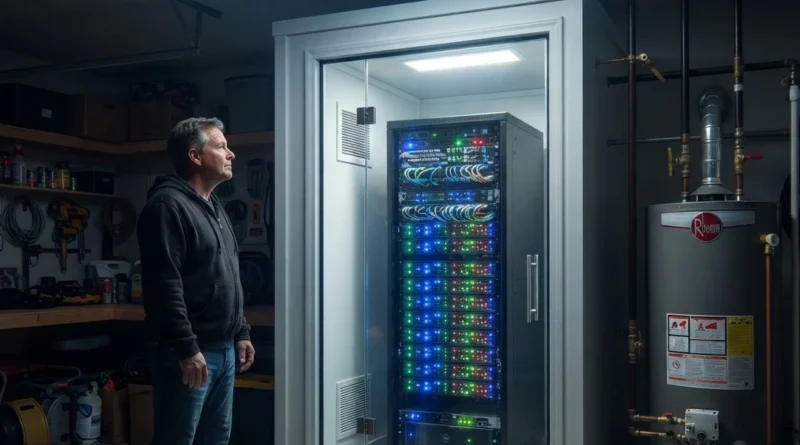
If I return to my earlier reference to an old blog I wrote, I mention the idea of the home appliance, something like the equivalent of an EMC SAN that families have similar to a water heater that one stores in the garage. When I thought about the various problems that exist now, issues of space, power consumption, long term investment, privacy, security, information redundancy (not in the good way), etc. I came to a solution where I needed to revisit to that blog post idea and show where I see direction of AI, data centers, privacy, media, etc. ought to be going.
Instead of doing a personalized mass SAN type of solution, I propose that homes receive their own version of something like a mainframe that contains all the computing power and storage along with limited processing software. Instead of these companies having your data, you would store your own data locally on this device in say a garage or some dedicated area that is spec’d out for this type of machine (which includes AC, proper power, redundancy, etc.)
Obviously, a new type of building and structure would be required for this type of system. Considering that there is a need for more public housing, perhaps the compromise between these monstrous data centers and housing is the introduction of a hybrid building. Maybe a new apartment complex could have an underground storage facility that contains these units that people hook into and bring with them when they go to a rent a place. Or perhaps, spare rooms in an existing building can be used with some authorization by property management to include these specialized facilities (and some of us have the room capacity for this).
However, here’s where the investment strategy part comes into play. Instead of people paying for these systems in the near term future, these large companies will be the ones paying for these systems. Not only will they be paying for the upkeep and construction, but they will pay you for access. So no longer will people worry as much about some data breach that occurs outside of their control. Now, they just need to worry about managing their own breach. But investors can then pay for these systems so that a new type of DC is built out to reduce the typical behemoths.
In terms of software, I think about my experience working in a bank where I viewed the pre-cloud solution where it was heavy client-server architecture. I think the cloud stinks in all honesty. My belief is that so-called web programming has made computing a lot more difficult than necessary in putting ridiculous pressure on the idea of live service systems with 24/7 support, etc. The front end in particular is dogshit to me since developers can’t make up their goddamn minds in terms of how they want to do things and you end up with these bloated front ends that don’t perform well, expose a bunch of security hazards and create more frustrations for everyone involved compared to a simple C++ compiled app.
I think of how with the problems of the increase in bot traffic have made the web into a human dead zone. The other night I was viewing some recently created YouTube videos for Disney’s The Black Hole and my first impression was that the videos were obviously AI generated. However, I noticed the traffic for a few of these (one had 93k views despite only being up for two days!) which got me interested in checking out not only the content but the comment section. I think a good chunk of the comments were fake too.
Because of this open web that we have, the idea of the information super highway has died a sad and ironically lonely death. So I think that to salvage what exist what we need are these systems that are locked down locally and are managed by us but paid for by these larger companies to gain access. Then for the content itself, we would need something like a sophisticated, heavily authorization based sharing system. That way, people can still broadcast things that they want to share between trusted people but avoid problems with children, data hostage scenarios (like the way these companies convert YOU into the product), etc. Content like blogs would be revised into these texts pieces stored that can be distributed and read through some client reader.
Now, what happens to monetization for old content? I have to be honest here, I think it should go away. I think the way the web has evolved into this low grade reward system where it’s like a broader version of some form of Jackass has harmed society in more ways than one. I really want to see the de-incentivization of things like TikTok and reaction videos where people who are lazy, uncreative and not appealing to look at (if we’re being truthful here) don’t make ez money from this terrible system. It makes people with actual skills at writing or any form of legitimate content creation (meaning you are an actual artist type) feel worthless in the scheme of things vs the way some people are simply better at networking.
AI itself becomes a local processing piece that is an assistant to those in that household. It should learn about the person but that person should be able to give that assistant parameters. And like other information on that person, the person (and household) ought to be able to control what goes out if companies desire access to this data as well as being able to compensate these people for what they are providing.
However, I did also mention the idea of redundant information systems at large. Meaning, what happens with a scenario where one wants to query the cast for Alien? What should happen? My belief is that we need an open source version of mass trained data that is NOT walled off similar to a Wikipedia. No one should be able to own it but the data should be heavily monitored for correctness. I believe that it should be one of the few types of centralized systems of its kind but that people can “borrow” information from it much like a person going to a library would check out a book. I think this is the next version of the Information Super Highway where we remove the commercialism for it and create a new standard because our current standards have rotted underneath us. Then combining this private and public type of systems, I think AI can prosper without the current problems.