
Dark Side of the Ring the Big Boss Man Review
So I ended up skipping the review for the Necro Butcher vs Samoa Joe episode mostly because I had little to offer outside of gross, there’s a lot of stupid people in this one (except Samoa Joe who unfortunately was involved in that moment) and I hate garbage/indy wrestling even more. I might come back to that later in this post, but the main focus for this blog is on The Big Boss Man episode, featuring Ray Traylor.
This episode was more of the tragic ending for Ray Traylor, who probably most people growing up in the late 80s/early 90s watching the WWF knew as The Big Boss Man. For me, I got to see him with Jim Cornette and the Midnight Express in ’86 during his NWA years. He was such a great figure back then as this silent, intimidating bodyguard character for Jim Cornette, who could get involved in a match when the time called. They touched briefly on his involvement with the two infamous Skywalker/scaffold matches involving the Midnight Express and the Road Warriors the later the Rock n Roll Express with the story about how he missed catching Jim Cornette. Since I didn’t have cable back then, I only knew about the scaffold matches either through magazines or clips on the weekend TV programs.
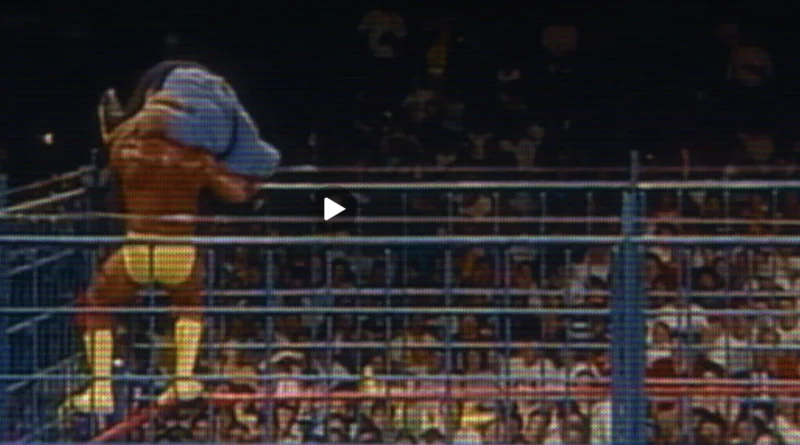
They show how Ray Traylor would transition to the WWF in the late 80s where Vince McMahon learned about Traylor’s background as a correction’s officer, leading to Traylor’s most famous run as The Big Boss Man. His size and quickness allowed him to feud with the still popular Hulk Hogan in a period where Hogan was on top and could still wrestle reasonably well. The main clip used was the superplex off the top of a cage that The Big Boss Man was able to pull off, which people considered incredibly impressive for both men to do especially at their size.
Gradually, The Big Boss Man would become a babyface, having major feuds with people like Curt Hennig (aka Mr. Perfect), the Mountie (Jack Rougeau, who actually dressed up in his full Mountie gimmick here) and later Nailz (Kevin Kelly). They didn’t mentioned the Nailz feud (probably because it was awful) but did manage to bring up the one with The Mountie. Of course, in asking Jack Rougeau if he really was a Mountie, he answered, “No, but I was a real jerk.” That was for a good laugh.
One part conveniently did not mention was Ray Traylor going to Japan for All Japan Pro-Wrestling in ’93 for a short stint. According to his Wiki page, Traylor would be called Big Bubba, just like his NWA name and was used more heavily in tag team matches and tournaments.
Afterwards, he returned to the renamed WCW promotion as just The Boss. He suffered through various gimmicks because the WWF, of course, owned The Big Boss Man name. And while that fanbase did still know him as Big Bubba, WCW and their general lack of creativity kept giving bad gimmicks until he eventually landed on his real name. He did have a few high profile matches and even joined the NWO. But simply as Ray Traylor, he lost his oomph and faded more to the background as the roster filled up with bigger names. The show did fail to mention that instance of him as being part of the NWO but I suppose in the scheme of things it would simply demonstrate how little he meant to people like Eric Bischoff later on.
From there, he would return to the WWF during the Attitude Era as an upgraded version of the Big Boss Man, using a swat team type of uniform and serve as Vince McMahon’s bodyguard in the Corporation. Here’s where my history of Ray Traylor severely becomes hampered as I hated this period of wrestling. All the stupid crap Russo was putting on during this period are things I try to put out of my mind. They showed the hanging moment, the chair shot, a stupid dog food moment (where Al Snow was fed his own dog). It was just horrendous.
But let me comment here about something Al Snow said that infuriates me. He talked about that segment with the dog food situation and said, “Pro-wrestling can be anything you want it to be.” That’s more modern wrestling gibberish. That line of thought is why pro-wrestling sucks so horribly right now because people think you can make it into anything. Because of that we have stupid schlock like that gay ghoul on the WWE, for which I’m boycotting as long as he’s on. It’s just all stuff done in bad taste, which Al Snow did admit. But this stuff has turned pro-wrestling into such a horrible joke that it’s almost in a state of no return.
Around this period though, the damage started to accumulate and the effects seemed to become more apparent at home. They did mention the soma drugs, which seemed to be on the rise sometime during the mid 90s that would help block off some of the pain. Since Ray Traylor wasn’t a known party type, this was a situation that would gradually spell the end for him as he became addicted and his physical well being would spiral out of control like other wrestlers from around this time. One doctor was named here that I think got arrested and the daughter effectively labeled as a drug pusher (which I do believe; the difference is that as a doctor, he would seem more legitimate and be able to legally get away with things).
Another thing that affected Ray Traylor mentioned here was his friend Curt Hennig’s demise that only occurred about a year before his own passing. The wife mentioned discovering Ray’s body downstairs but being unable to administer help, which was attempted by the daughter who studied CPR. There is some survivors guilt here but the family did manage to move on.
One thing I will mention is that I have to wonder whether the increase of somas and painkillers were a thing from the harder style that started to spring up from the mid 90s onward or whether this situation would be inevitable given the differences in physiques compared to earlier stars. The one thing is that Ray Traylor was never a real muscular type but it does seem that the Attitude Era with the harder style might’ve accelerated the use of pain medication and somas. They did say that his condition was hereditary though as he did die of a heart attack. It seems that the incident was fairly common with those people around that period.
At any rate, this was more of a tragedy of this character/person. For the most part, Ray Traylor’s life seemed pretty decent in that he wasn’t a troublemaker and considered a pretty decent person, who was a great family man. The dark parts were more about the change in pro-wrestling landscape that he got caught up in but saw as a necessity to continue caring for his family.