Enter the Clones of Bruce Lee Review (2023)
Anyone who knows me realizes that one of my favorite topics is old kung fu movies. The Shaw Brothers were my favorites as opposed to the stuff done by Bruce Lee, Jackie Chan or others that came later. Beyond the Shaw Brothers stuff, I was a moderate fan of Bruceploitation movies, especially once I became more aware of this entire genre dedicated to the master himself. What I found entertaining about the genre was the variance in terms of movie quality where some weren’t half bad while others were sheer rotten obvious knock offs. Generally speaking though, many Bruceploitation movies turned out quite fun in their own right for one reason or another. Enter the Clones of Bruce Lee (2023) documents the Bruceploitation genre, briefly going over the legacy of Bruce Lee but focusing on the stars, producers and history of the genre as well as how the next generation of Kung Fu stars would break out with Sammo Hung and Jackie Chan.
The movie starts by covering the meteoric rise of Bruce Lee and his quick fall. Part of it showed the old Shaw Brothers studio with Chang Cheh as the master director behind numerous classics. One thing I didn’t realize was that the documentary covered was how Bruce Lee showed up not only as an action coordinator but wanted to apply for a role. Apparently, Chang Cheh rejected the arrogant but obviously talented Bruce Lee when he asked for a leading role, calling him a nobody. Inadvertently, that bad call would be the start of the rise of Golden Harvest, the other major studio in that period. However, Golden Harvest had been struggling.
With Bruce Lee at the forefront, he became a sensation, although his identity would be altered to fit a more Chinese narrative (for instance, saying he only lived in America briefly as opposed to being born there in San Francisco). Bruce’s magnetic personality with unique traits such as his movements and trademarked noises would bring him great admiration. Of course, he would get his biggest break with Enter the Dragon that not only gave him global fame but helped make other major stars who participated in the movie.
Alas, Bruce Lee’s life would be tragically cut short. Like an Asian James Dean, Bruce would only live to be 32. His funeral had been broadcast as a camera crew filmed the scenes. But it was clear that the demand for more Bruce Lee was there and that’s where the start of the Bruceploitation began.
From the various copycat actors, the first introduced was Bruce Li, aka Ho Chung-ta. Amazingly, the film crew managed to get him as he had been somewhat elusive after leaving the industry (I read he might’ve refused other movies done in a similar vein especially the infamous Clones of Bruce Lee). I would say that of the copycats, Bruce Li probably is the best known. Basically, he was a martial artists that managed to get a role that caught someone’s eye in terms of his appearance. He would go on to study Bruce Lee’s movements and behavior that would allow him to mimic Bruce.
To be fair, I would say Ho Chung-ta probably was the best of the main three but I think that was more due to his acting ability. Some of his movies are actually decent and can stand on their own. He himself admits on the film that one person told him that if he didn’t look like Bruce, he probably would’ve gone farther. Also, of the three main guys, Ho Chung-ta seemed to actually be someone of good character. He wasn’t in it for money and he had somewhat of a guilty conscience for taking over the role. Once his wife became sick, he was forced to leave the industry to bring up his sons. Afterwards, he ended up both training new students and becoming a physical education instructor. I thought for his age in the movie (about 73), Ho Chung-ta looked decent and could still move in demonstrating some kung fu.
From there, the movie switches to South Korea where another upstart named Dragon Lee, or Moon Kyoung-seok, would become another clone. Dragon Lee would boast a massive physique and is said to have been obsessed with Bruce. The thing about Dragon Lee is that he had more of the mannerisms down for Bruce Lee but not the actual martial arts that Bruce Lee had been doing. His earlier films were more period pieces and he was brought to Hong Kong. Gradually, he had a few reasonably successful movies on his own such as The Hero, The Dragon and the infamous Rage of the Dragon (which I did review).
The thing with Dragon Lee though is that he gradually moved more towards comedy. Both Dragon Lee and Godfrey Ho were interviewed here but the movie did not directly connect these two as a pairing. One of the things I read at one point was how Godfrey Ho used Dragon Lee as a kind of pet project. The documentary does mention how The Hero, The Dragon utilized Dragon Lee in a bizarre, more modern fashion whereas the main portion of the movie was more of a period piece, or at least the kung fu was.
Dragon Lee did admit that he wished he did better for himself, namely being a better husband and father. I guess he wasn’t faithful and/or had issues with his wife at one time. However, I will say that of the impersonators, Dragon Lee probably looked the best at his age. There were close ups of his hands though and you could see that his knuckles had some sort of bubbles like warts or scarring so possibly the damage from practicing over the years may have cost him somewhat.
After Dragon Lee, comes the last of the major Bruce Lee impersonators: Bruce Le or Wong Kin-lung. I believe they mentioned that Bruce Le might’ve joined the Shaw Brothers or at least appeared in one of their movies before someone figured that he could play another clone. But the fascinating part of his story came in how he was in Burma and knew kung fu but the Burmese government had expelled all those of Chinese origin. However, because he only knew kung fu, it was the thing that got him by. They talked about how they would give him a bowl hair cut and some sunglasses since he had legit kung fu skills and could copy the mannerisms of Bruce Lee. For my money though, he was the least interesting of the three both in terms of his movies and his character. He legitimately comes across as arrogant and the least ashamed about the money grab. One of the things the documentary points out is how Bruce Le’s movies later would involve him in James Bond-like roles as well as having numerous topless female scenes. So he’s probably the worst exploiter of the lot by far.
The movie then goes into how the exploitation genre would start to get ridiculous such as using people from some of the Bruce Lee movies and doing “what if” scenarios by pitting a Bruce Lee clone against someone Bruce Lee hadn’t fought in his movies. An example is the hulk of kung fu, Bolo Yeung. One great part has his son talking in English about his father. I will say his son, just like his father, is fucking HUGE.
Another guy they brought up was Jim Kelly, who also was in Enter the Dragon. In Jim Kelly’s case, they mentioned the combined genres of Blaxploitation with Bruceploitation. One of the best lines came from a promo from one of Jim Kelly’s movies calling him “James Bond and Bruce Lee rolled up into one.” Unfortunately, Jim Kelly passed in 2013 from Cancer at the age of 67 so he wasn’t able to participate on this documentary.
Not only did the genre have male stars and stars outside of China, but females too. The predominant person mentioned here was Angela Mao. Like Jim Kelly and Bolo Yeung, Angela Mao had a brief role in Enter the Dragon. They managed to get the actual former actress here too and she looked great. I say former because she retired from acting in ’92 to start a family and would later move to NY to run a few restaurants. Here, she mostly was grateful to Bruce Lee and the people involved with her career as many fans still remember her.
Another part they touched upon is the roughness of the shoots. They mentioned how the choreography could involve up to 100+ moves in a single, long shot compared to the shorter shots that are done with editing in contemporary movies. Also, they discussed how unforgiving these shoots were in terms of getting injured along with the grueling schedule. It wasn’t uncommon for them to do multiple pictures in a single day, which left them few days off and little time to rest.
Also, they talked about the effect of Bruce Lee in terms of Asian perception. In Western portrayal, the roles were limited to Japanese soldiers, some flunky, geisha or prostitute and maybe a girlfriend of the white guy. Bruce Leung (another impersonator but not as prolific) mentions that this limitation was due to education (meaning understanding of culture) and how Western dominance was the thing until Bruce came along. One analyst mentioned how not only was kung fu popular with the Asian crowd but the African American crowd too.
And let me pause here to say that at least as a South Bay kid growing up, I can definitely attest to the popularity of Bruce Lee and kung fu out here. My friends and I would watch these movies because they’d come on during the weekends with Black Belt Theater on Channel 11 showing mostly Shaw Brothers imports or Channel 9 with more independent stuff. You’d get a few other channels that might be on late at night or the rare specials on Channel 13. But many of us would pretend to be Bruce Lee, make jokes about him (what is Bruce Lee’s favorite drink? Wat-tah!) or make those strange kung fu noises as we’d play fight outside. Of course, one of the most famous South Bay people involved in film, Quentin Tarantino was a known kung fu afficianado and even did the Kill Bill series as a homage to kung fu. The analyst said the identification with the black community was in part about the underdog beating the system. My belief is that kung fu looked cool, was accessible (for us) and was exciting to watch. It just became part of our lives growing up out here.
From there, the documentary dives into the seedier aspects of the Bruceploitation genre, which is the actual exploitation aspects. Doing things like calling a movie “Bruce Lee” or using posters with elements from Bruce Lee’s movies, these shady individuals would cater to a crowd that they hoped would not know the difference (hey, because all of us Asians look alike right?) One of the more nefarious moments involved someone clipping the actual image of Bruce Lee in his coffin and pasting it onto a small section for a poster. I mean it just shows how low some of these people would go to sell these products. However, there were enough hardcore fans that would recognize that the person involved once they saw the film wasn’t the real Bruce Lee.
In one of the funnier moments, they showed one of these shady distributors, who found Yasuaki Kurata, and relabeled him as “Bruce Lo” for a movie called The Tigers Claw. They even had the still living Yasuaki Kurata for the interview and hand him the poster with the Bruce Lo name and everyone laughed. There was a clip of Yasuaki Kurata fighting Gordon Liu in the Shaw Brother’s Heroes of the East where Kurata did his famous “crab technique,” where he explained how his style was Japanese (because, well, he is Japanese).
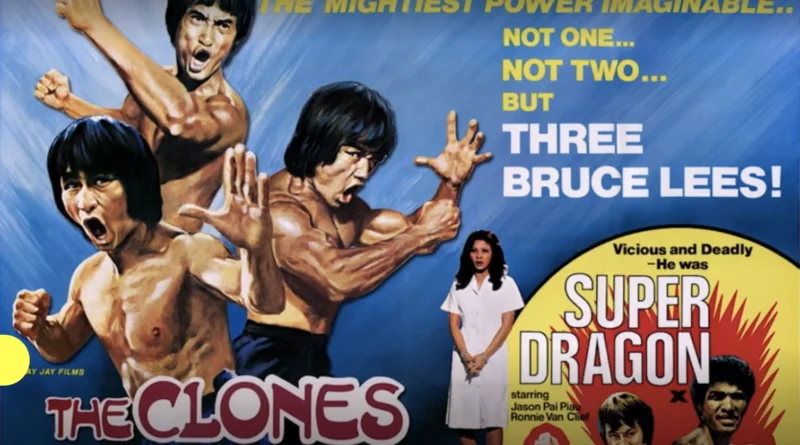
Of course, you can’t have a documentary called “Enter the Clones of Bruce Lee” without talking about the rare and possibly the most exploitive of the series The Clones of Bruce Lee (1981). The main thing here was how they managed to get two of the three big Bruce Lee imposters to appear (with Bruce Li not wanting to have anything to do with this apparently) along with Bolo Yeung. And there were two additional guys who would have some resemblance to Bruce Lee, with one called Bruce Lai being Bruce #3. Bruce Lai (or Chang Yi-tao) was a South Korean martial artists with a few roles prior to this. Bruce Le mentioned taking the guy under his wing and helping him out. One other person calling himself Bruce Thai or Bruce Tai (because they were in Thailand????) only got the job I guess because they gave him a hair cut and sunglasses and called him “Chuck.” I almost would think the purpose of this whole documentary was to actually leading to this point based on the name and the fact that this segment got a reasonable spot which went into the actual curious filming aspects, something some of the other Bruceploitation films would not get a chance to really do any deep dives into. Sadly, no one talked about the mysterious abrupt ending of the film nor what was intended.
Another infamous clone film that was done completely tongue-in-cheek shown here was The Dragon Lives Again (1977) with Bruce Leung. Fortunately for the film makers, they were able to get Bruce Leung for this documentary as he had passed away earlier this year. But he was able to talk a little bit about his background growing up, wanting to protect his family, who were poor, and thus learning kung fu. But I think the message here (along with other people in this genre who made a career from Bruceploitation films) was that they often were poor people who just needed the money. As for The Dragon Lives Again, like The Clones of Bruce Lee, this movie was given a little more detail, showing the sheer insanity with the bizarro world characters that exploited a variety of genres across movies like Popeye, Clint Eastwood and James Bond. But people would realize that this movie was done more as a comedic homage to Bruce Lee rather than a pure exploitation film in itself.
Another movie that they discussed that was exploited in its own right was Game of Death. While there’s been variations of the movie, the original has been widely known to only have 30 minutes of actual usable film. In turn, the movie employed actors and various tricks with other Bruce Lee movies to give the impression it was a finished product. The film maker himself (outside of Bruce Lee) mentioned that there’s nothing more available, despite conspiracies of how he had extra footage that he could use to pay for his retirement or some strange statement like that.
From there, the documentary starts to look at what was coming up the pike in the kung fu genre. They brought in Sammo Hung for this as he was also involved in Enter the Dragon but had become both a great choreographer, actor and film maker in his own right. He took the Bruceploitation film in a different direction where he managed to produce Enter the Fat Dragon, which wasn’t so much about Bruce Lee but a meta statement about Sammo as this non-idealized actor that could actually pull off all the same moves as Bruce Lee.
A weird tidbit comes in the form of the accepting of Bruce Lee’s passing as the Bruceploitation genre starts to wear thin. There’s a scene from one of Bruce Li’s movies (one of the semi-biopics) that ends with the conspiracy of Bruce Lee still being alive, but as a recluse awaiting to return in 1983, 10 years after his death. Obviously, that never manifested but the kung fu genre would continue to prosper without him.
The next big thing would be the combination of comedy with kung fu lead not only by Sammo Hung but the main forerunner of Jackie Chan. Of the prominent people still involved, Jackie was the only major person missing in this group. But the interesting note was the description of the Jackie Chan style movie where you have someone who would get beaten up throughout the movie only to prevail at the end. They didn’t really mention Jackie’s techniques like “wire-fu” replacing more legitimate martial arts. But I think most people would recognize Jackie Chan as one of the premier martial arts action stars that still is around.
The film concludes with the three main clones showing what they’re up to these days. I think Bruce Le probably is the most game of the three and probably can still go if he’d want. But the others have moved on.
For the most part, I found this documentary to be really solid. I was particularly impressed by how almost all the key people involved were given a fair amount of screen time and it was nice seeing where they are today (or those that managed to survive). They covered a wide variety of topics and showed a few of the more nefarious moments (including the Bruce Lee Fights Back from the Grave). Maybe the only person they didn’t mention was Lau Kar-Wing, who might’ve received a small credit for a Bruce Lee type of film but I’m guessing it was too insignificant.
At times, it did feel as though they just name dropped a lot of things without context like various movies. But I think it was more of a case where they needed to comb through a lot of ground and couldn’t go into as much depth as they may have wanted. I think the main points were showing just how wide the whole Bruceploitation phenomenon had gone and to what extent, which would give most people who were interested a taste of the Bruce Lee craze and one of the major aftermaths.
At any rate, I highly recommend giving this documentary a shot since it’s on TubiTV right now and for any Bruce Lee and/or Bruceploitation fan, this is a fun and memorable thing to watch.