
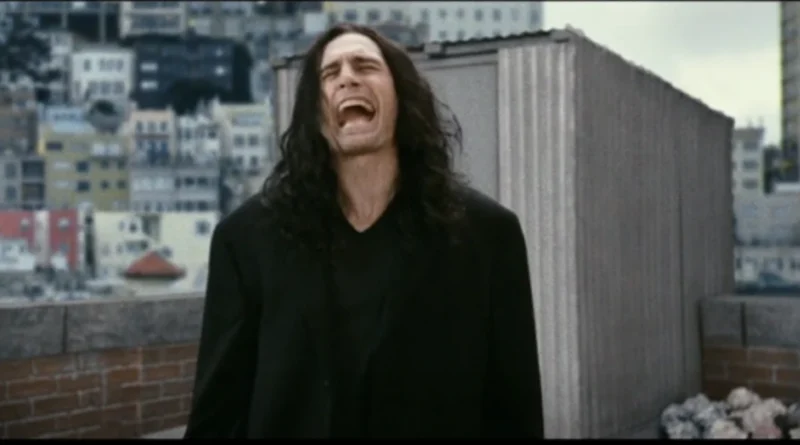
The Disaster Artist (2017) Review
At one of my previous companies, we would have one of those team building exercises in the form of a bad movie night. Amongst the movies selected was Tommy Wiseau’s infamous The Room (2003). It became an instant hit for those who had the chance to view it and we probably saw it at least one more time. Later, once we moved to a bigger building, The Disaster Artist (2017) came out and we decided to do our last bad movie night with this one, even though The Disaster Artist is more of a biography/making of The Room rather than a bad movie itself. For myself, I was kinda hooked into the idea of The Room being this oddball, underground cultural phenomenon and became curious because of the people involved in this picture.
The Disaster Artist is mostly based upon Greg Sestero, who plays Mark in The Room, and his book. The movie is done by the Franco brothers, David and James, along with an ensemble Hollywood cast. From what I’ve read, The Disaster Artist exaggerates and fictionalizes some elements on what actually happened for the sake of a film. But I partly read that not only as a way to serve your usual Hollywood fairy tale story but as a way to pay tribute to The Room, which to me is a fascinating movie for Hollywood insiders since it was done in an unconventional manner while garnering a cult status that rivals The Rocky Horror Picture Show.
While the narrative perspective mostly is done through the lens of Greg Sestero, who provides the back story from his book, the main character is Tommy Wiseau as he’s portrayed as this mysterious person of whom no one has ever learned 1) what his real age is; 2) where he really is from; and 3) how he accumulated his wealth. And you have to consider Tommy Wiseau a character in a very literal sense of the word as he is distinct from anyone one may encounter and seems to operate on his own wavelength and perpetually surrounded by a reality distortion field.
But the main story is how Greg Sestero, who is your typical struggling actor, encounters Tommy Wiseau during one of his classes while in SF and finds his presentation utterly fascinating to the point where he befriends Tommy. From there, Tommy adopts Sestero as a kind of blood brother where he upends Sestero’s quiet life in SF to have Greg follow him to LA on whim where he own/rents his own apartment. The glossy eyed, naive Sestero agrees to this abrupt change in life where he merely hops in Tommy’s car with his luggage and barely says farewell to his mother (who is played by Megan Mullally here briefly)
In turn, Greg starts to adopt the standard actor life in LA seemingly, getting an agent (played by Sharon Stone), finding small roles, mingling with other actors, etc. while Tommy remains in a separate universe, behaving in an extreme albeit bold mannerism that defies social convention. During this period, Greg forms a relationship with a bartender girl (played by his gf/future wife Alison Brie) while Tommy manages more social faux pas encounters such as aggravating a Hollywood producer (played by Judd Apatow). Still, Greg has problems securing any real roles and the two come to the conclusion of making their own movie.
Tommy disappears to write The Room (which reportedly took 9 months or so) and returns with the script for Greg to read at Canter’s Deli. Thereafter, they begin the process of filming, where they buy the actual equipment rather than rent it (which is what most productions do), hire the crew and go through castings. Once the production starts though, numerous issues emerge, most of all Tommy’s control freakish nature. Also, amongst these issues is Tommy’s utter incompetence as an actor where apparently he forgets the very lines he wrote.
One of the more humanizing aspects in the movie is where Greg has lunch with the other actors on set. This was after the heat exhaustion situation where the woman playing Claudette from The Room (Jackie Weaver as Carolyn Minnott) talk about the whys of acting to Greg. Here, Carolyn mentions how being an actor is better than any other job in the world, which is why they’d drive out for miles through traffic and get up at terrible times to perform, even if they experience uncomfortable situations like heat exhaustion. I don’t know if Sestero himself had that experience with the actual actors on set and wrote it in the book, but it does seem like something the more experienced people involved in this movie would have told the audience, especially aspiring actors.
In one supposedly fictionalized encounter, Sestero and his girlfriend Amber encounter Bryan Cranston (in another cameo). Amber apparently goes to Pilates with Cranston and introduces Sestero as a fellow actor. Since Cranston is filming a Malcolm in the Middle episode with the need of a lumberjack character, he sees the potential of using Sestero as he bears a beard here. In turn, when Sestero tries to talk with Tommy about pushing the production for his shaving scene up by a day, Tommy gets upset and forces Sestero to choose between the two. As a result, Sestero ends up choosing The Room, gets himself shaved and does the infamous tuxedo scene (cheap cheap cheap!) Afterwards, Greg gets into a confrontation with Wiseau where he questions the three things yet to be discovered about Tommy and the two have a scrap which leads Tommy supposedly to end filming and depart.
A little while later after the film wraps up (which apparently was really off schedule), Greg now is working in theater, has broken up with Amber and gets invited to a screening of The Room by Tommy. At this point, the film is wrapping up and things seem to be getting cut off like resolving why Greg no longer possesses his resentment towards Tommy or why Tommy would even bother to forgive Greg after their confrontation. At the very least, it paints Greg’s character in the movie being this passive person who easily gets dragged along and really has no direction outside of this bare bones idea of being an actor. So I found this so-called reconciliation weird.
The two board a limo that Tommy rents and Tommy attempts to treat The Room like a world class premier with a spotlight and even having his vampiric image on some key placed billboards around town. On top of that, rather than arriving like a normal person would, Tommy has the limo circle the block “to build anticipation” (more probably because he expected a hotter, larger crowd than the small one that was waiting outside).
The cast are invited and a bunch of other people that are never identified. Supposedly, it’s a fair sized crowd for the premier. I don’t know if the original crowd was of that same size but parts of the portrayal here were true. But to me this is the best part of the movie because we get to see the “remake” of the movie, the cast and their reactions and how I think a lot of people upon first viewing The Room probably see it. For instance, Seth Rogen notices the two title cards. From there it just goes downhill for Tommy as reactions are mixed as people have no idea what they’re watching, the awkward sex scenes that make the participants highly uncomfortable, Tommy’s hilariously poor acting abilities and the serendipitous and infamously placed non sequitur moments such as “I definitely have breast cancer” lines.
Yet as Tommy perceives the audience as laughing at him, Greg has a different epiphany. Tommy storms out to wallow in self pity but Greg reassures him about his achievement and verifies the special nature of The Room from the sheer joy that the audience is experiencing. Greg encourages Tommy to return inside the theater as the movie concludes with the audience chanting “Do it!” much like a certain Judas Priest incident for which Tommy’s character of Johnny puts the gun in his mouth and pulls the trigger, which causes the audience to erupt in mad applause.
Despite the fact that the audience had just effectively cheered on Tommy/Johnny killing himself in the film, Tommy sees beyond that and fully embraces this different perspective where he tells the audience that he’s glad that they enjoyed his comedy as he intended. Also, he invites Greg to join him as his soulmate for helping to make the film.
Afterwards, there’s an outro that gives a little more on the current IRL version of Tommy Wiseau and Greg Sestero, mentioning the eventual cult-like success that has made both people into celebrities and even making back the money spent. In addition, the same three questions are not answered at this point about Tommy’s background. Then we get the fun part of the film where both the actual The Room is placed side-by-side with the Franco’s version. You can see in these scenes how dedicated the cast and filming were in trying to recreate as closely as possible certain key scenes. For my money, the person that impressed me the most was Ari Graynor, who nailed her lines and movements almost in scary synchronicity with Juliette Danielle’s a good deal of the time.
So I think The Disaster Artist movie itself really isn’t a true biographical replica of what Sestero’s book probably had written. Instead, it seems to cover the overarching points and fabricate events to create certain artificial tensions at times (or perhaps even underplaying parts such as the high turn over rate during the filming). But I think the movie really was more for insiders of the Hollywood industry as something that examines this curiosity of The Room and this odd character named Tommy Wiseau where the whole thing is a mystery in itself.
A lot of the humor to me is more for people inside of the Hollywood business such as the “two title cards” line by Seth Rogen or the fact that Tommy Wiseau purchased rather than rented the equipment. This is certainly one of those instances of “Hollywood talking about Hollywood” but in this situation it actually works really well because of the surreal subject matter.
I think everyone involved looked like they had a party filming this thing where you had this ensemble cast that were used to make commentary on the whole Hollywood system itself. One of the terms I heard from interviews was the use of “outsider art.” And while The Room itself is flawed, I think the genuineness and lack of convention is what makes it a fascinating case study for those within Hollywood, which is why everyone involved in this film looked as though they were having a blast.
I did center that the real “star” or main character in this film is Tommy Wiseau. To me he is like a real life Joker from The Dark Knight. Someone once explained the Joker from The Dark Knight wasn’t necessarily good “acting” because the Joker never showed any actual motivations, which is the driving force behind every character. Here, Tommy’s shrouded behavior and even his appearance has that Joker quality. So while James Franco is able to highlight Tommy’s quirks, we don’t understand what makes him that way. There’s simply not enough information on Tommy to really make him relatable except that he obviously has this abstract dream of making movies that Greg does.
On the other hand, Greg seems more relatable as this observer character. He’s effectively the prototypical starving artist type, who is desperately trying to find himself. I think like Tommy, Greg’s character is severely underdeveloped but shows characteristics that make him more relatable like his vulnerability, his lack of confidence and him having these big dreams. However, we still don’t get a lot about him as a person. Like why would he suddenly hop in a car with a total stranger on a whim and leave his poor mother behind? In a way, the best way I can describe the Greg character in this movie is the Hollywood “everyman” type. The main difference is that he managed to hitch up with the right person for the wrong deal.
I’ve read some of the criticisms of the movie especially with regards to not being completely factual. Certainly, The Disaster Artist has made the making of The Room into its own standard Hollywood type of movie as much as it could. But I see two agendas within the movie. First, this movie obviously is the Francos way of doing their version of a cover song except for a movie except not doing the entire movie scene for scene. Instead, they were very selective in grabbing the bigger, more memorable parts from The Room. And you can see them really enjoying themselves since they can do their own version.
The second aspect is that I think this is their way of giving praise to Tommy and Greg for their efforts. The audience applauding the pair is not what I read actually happening, although the audience did laugh hysterically during the actual premier and even demanded their money back. However, I think the Francos and various people in Hollywood see a perverse genius in Tommy Wiseau in that form of film making because of how it manages to defy the odds, given how formulaic most of Hollywood has become. Tommy’s disappointment in The Disaster Artist (the character not the real person) revolves around his own exposure of himself with this movie he felt proud of and that uncompromising vision is what I think the Francos and people involved appreciate more than anything.
For myself, I can certainly appreciate the sentiment displayed here as a writer. When you finish something, even if you believe in it, others may not see it the same way as you do. Worse yet, some people might ridicule you and your hopes and dreams can be easily demolished. Probably, the biggest reminder of this notion is the “I definitely have breast cancer” line where you toss something out casually that seems important in your mind but the rest of the audience has no clue where it came from nor where it’s going (or if it just dies as in this case where it comes out of nowhere). Moments like those are what keep someone like me humble and cautious.
Lastly, I have to talk about the swapping of Tommy’s attitude when he accepts the reaction from the audience in embracing the idea that he produced a comedy. I know he’s tried to produce more films (even with Greg) but nothing that I know of has reached the same status as The Room. Some say part of the problem was becoming self aware and how that’s a curse because it forces one to try and replicate the previous state without really knowing why it worked. A frequent comparison to this “outsider artist” type is Neil Breen (whom I had the misfortune of viewing in terms of Fateful Findings). The difference from what people have said is that Neil Breen actually believes still to this day in what he’s doing and writing, which might either be a blessing or a curse. I mention this aspect because as someone who writes in a kind of egocentric perspective, I wonder whether I’m a Tommy Wiseau or Neil Breen. That kind of thought scares me because I am self aware but at the same time I’m unable to change how I think. But it is something that I’m constantly reminded me and haunts me in my own writing.