
Shaw Brothers Heaven and Hell (1980) Review
Quite possibly, the #ShawBrothers Heaven and Hell (1980) might be one of the weirdest movies I have seen from them. It’s not a standard #kungfu movie but more a morality play mixed in with some normal movie parts. In a way, it’s a bit of a hodgepodge in terms of how it’s filmed but I read part of that may be due to how filming started in 1975 but didn’t finish until 1980. So perhaps, the appearance and goals of this movie changed over time much like Ten Tigers of Kwungtung or The 8 Diagram Pole Fighter. Even so, this movie can appear quite incoherent as I’m utterly convinced part of it was filmed while under LSD.
Heaven and Hell is a three part act in terms of the characters involved. We start off with David Chiang, who got top billing in this part, in heaven and is in love with a woman there. Because this is an ensemble cast and where some people received multiple parts, I’m going to avoid providing the character names unless absolutely appropriate (e.g. Buddha) just because it’s hard to keep everyone’s identity straight here and much easier just using the actors’ real names. But in this section David’s lover is accused for failing some sort of ritual and their love is denied because I guess he’s some sort of guardian angel figure. In turn, he’s condemned and the two lovers decide to become mortal on earth by trying to escape.
En route to a special portal that will allow them to leave heaven (sounds like a bad idea) back to earth and become mortal (sounds like a REALLY bad idea), they must face various guardians, including Li Yi-Min, who really is the main viewpoint character for this odd movie. Li Yi-Min though has a sense of justice and decides to help the lovers, which in turn causes himself to be condemned and punished. On a side note, one of the guardian angelic figures here is played by Chiang Sheng, who goes by Na Cha. I make note of this character because Fu Sheng also got his first starring role as Na Cha the Great, so I imagine this figure has significance in Chinese religious/fantasy lore.
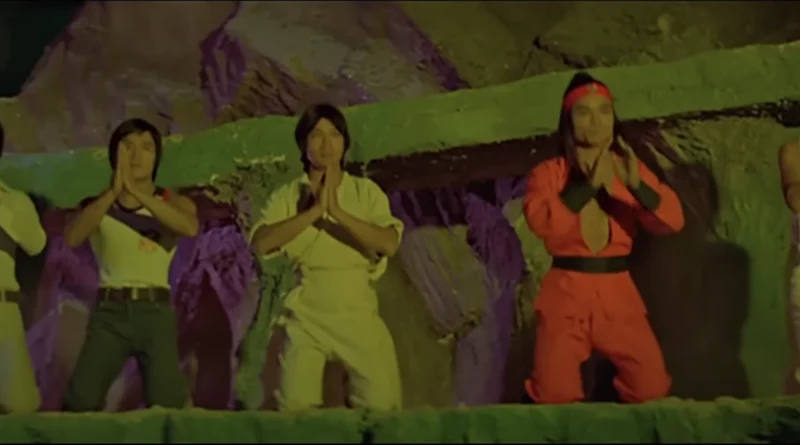
Another thing of note is that the setting for heaven looks utterly like shit and cheap with a ton of dry ice blowing. The costumes are over-the-top with the angels wearing glittering make up and using oversized balls for weapons. So the visuals here alone make this movie look ridiculous and more fit for a stage play. It makes me wonder what they were going for here. And these cheap visuals will continue throughout the movie.
For Li Yi-Min’s crime, he is reincarnated as a taxi driver back on earth. This is where the idea of reincarnation to me is utterly weird as it relates to how it’s depicted here. The taxi driver character does not go through a fetus status to present but that he’s made whole and just planted with a normal conscious of his previous existence as an angel. They don’t necessarily explain that whole process, which makes me think this movie really is geared towards an audience of strict Buddhist disposition because half of the references make no sense to me.
Anyway, this is the 2nd act where Fu Sheng and his girlfriend/wife Jenny Tseng still are billed above Li Yi-Min. This whole 2nd act is absolutely dreadful because we get multiple songs and dances from Fu Sheng and Jenny Tseng while on these ridiculous looking 70s types of hallucinogenic sets. These aren’t proper buildings but cardboard cutouts that make me think of an even cheaper version of Kubrick’s Clockwork Orange.
Regardless, the gist of this story is that Jenny works for some big boss played by Chiang Tao as a secretary taking millions of his calls. Some hoodlums show up and try to harass her but drop a briefcase full of drugs, which she sees. Chiang Tao shows up and doesn’t bother to defend her but I guess rapes her or lets his men do it. But this is part of a flashback since Fu Sheng has to rescue her. He manages to escape with her and jumps in Li Yi-Min’s taxi but gets ambushed by Wang Lung Wei. Li Yi-Min steps in to help but a gun is pulled on them and he intercepts the bullet, thus supposedly performing a good deed that ought to let him back into heaven. Weirdly, he casually drops, “Well, let’s go see what hell is like.” Seriously, WTF is with this stupid plot?
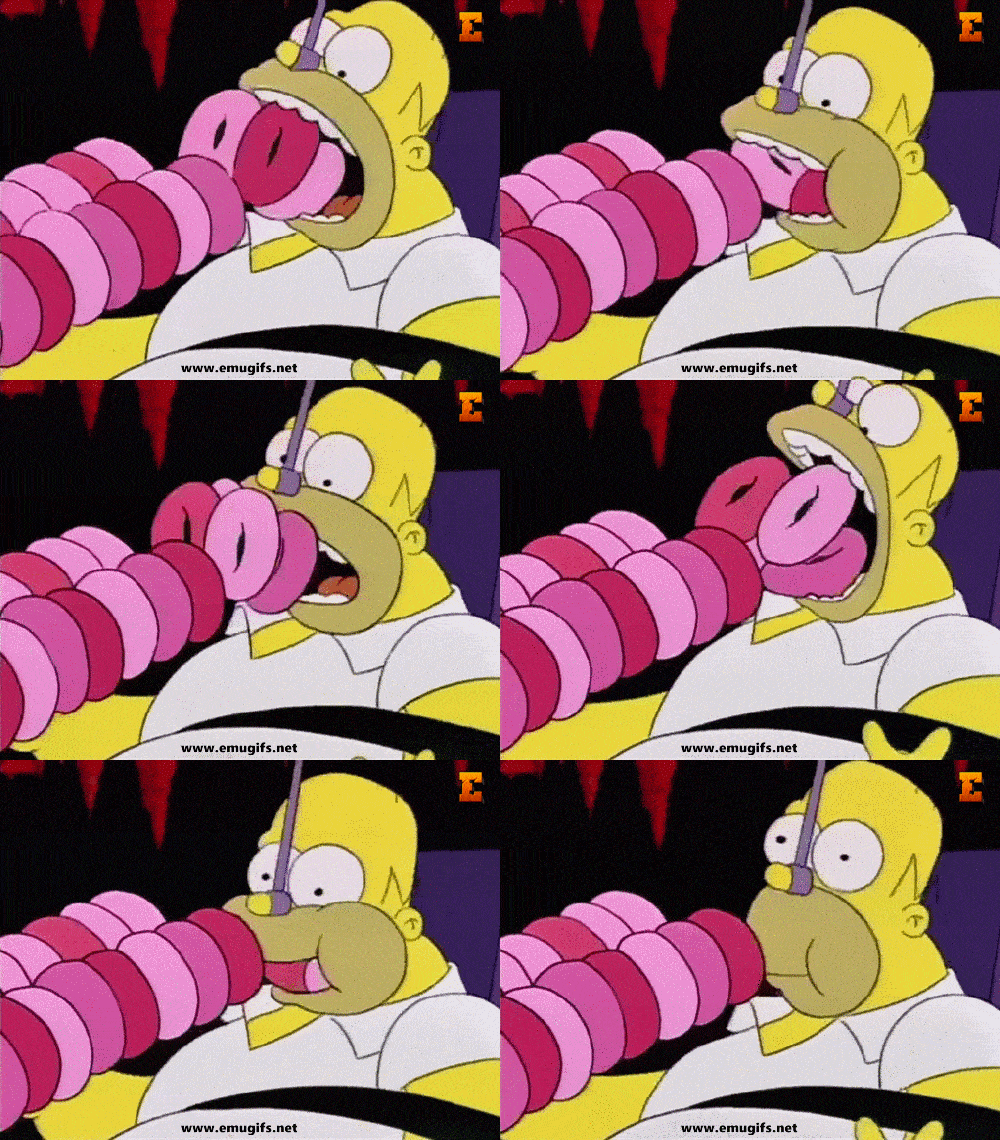
Then the long ass third act starts. Finally Li Yi-Min gets top billing for this part because the Venoms, who make up the bulk of the sub-characters in this section, aren’t as important yet to Chang Cheh. This is where things get really weird for the non-religious. Visually, things seem more like a cheap fantasy but are probably based on a literal interpretation of a Chinese/Buddhist Hell. For instance, you get demons with long tongues, or women who do nothing but gossip. Mixed in are tortures which are pretty much exacerbated vices for the sinners kinda like Homer Simpson when he was fed infinite donuts. Of course, the sinners end up hating their vices but are condemned for eternity with them.
Besides Li Yi-Min, a girl called Red Dress (played by Lin Chen-Chi) appears and accompanies Li Yi-Min. We learn her story is that she goes to some party, gets stone drunk and commits suicide for no apparent reason. For me that whole part of the film makes me believe that one of the film makers probably had that happen to themselves, which gave them the idea to create this movie. I mean this subplot comes out of nowhere and doesn’t necessarily explain why Red Dress goes to Hell, unless Buddhism also preaches that suicide is sin.
The pair encounter all types of oddball characters in their journey in trying to determine how to escape. Eventually, they come across this plow field of souls getting smashed by some tractor thing but suddenly pray to Buddha. Apparently, in Hell, once a year (which doesn’t make sense to me considering Hell ought to be eternal), these lost souls are greeted by the Buddha of Mercy and can pray for clemency. That day, of course, is when the Buddha of Mercy appears and both Li Yi-Min and Red Dress plead their case. In turn, they are given this odd quest to find additional people of blood to help fight their way from purgatory as their cases were unjustified.
So they come across Sun Chien, Bruce Tong, Lo Mang and Philip Kwok. Let me pause here briefly just to reveal how funny and ironic it is that three of the guys in Hell here typically are the ones Chang Cheh would kill off in all of his movies. Like this is almost like jobber heaven, uh, Hell here. Each time Li Yi-Min meets a new hero, he slices them with his blade to prove that they have blood and are human rather than a fake demon. Once he gets his version of the jobbers from Hell Avenger team assembled, they go back to the Buddha of Mercy where we get each of these new characters’ backstory.
In essence, the four have all been wronged in their previous life. So their killers because of their evilness are also in Hell and have taken the form of demonic guards. One comment I have in learning about the wide timeline for the way this movie was filmed, you can see the difference in appearance for some of these people. Like Philip Kwok and Lu Feng seem much younger as though Chang Cheh had shot some scenes but never used them from around the time Shaolin Temple was filmed. And Sun Chien’s scene involved a very young Kara Hui so that section might’ve been shot during or around The Chinatown Kid’s filming. But these scenes look really piecemeal as though Chang Cheh and Ni Kuang had various ideas but just tossed them when they didn’t work out and pulled them all back to make this hack of a film.
Regardless, the six must work together and face the forces of Hell to be able to eligible for reincarnation. They encountered all their arch nemesis once more and momentarily thwart them along with some of Hell’s devices like a frozen pit. In turn, the ruthless evil demons plead with the main devil/boss character so they’re empowered and work together to counter the six’s escape. The five heroes’ weapons are made ineffective and they get wounded easily, overwhelmed by their foes.
Then a literal Deux Ex Machina shows up in Na Cha (Chiang Sheng) and a few of the other major angels. He calls the situation “unfair”, uses his magic ring to cast a heavenly glow upon them all, which does a heal all spell, makes their weapons dangerous (probably +5 enchantment as per AD&D 1st edition rules) and removes all the traps while their foes become mortal/killable. So in a way, the four jobbers, who already died, in effect had died a 2nd time if you really think about it, but couldn’t be cast further down the jobber hole because they already were in Hell and it took a literal act of God for them to be able to win in the typical Chang Cheh Against All Odds (with disrespect towards Phil Collins) scenario.
I’m not going to even bother describing the stupid fights that go on because these were just stupid visually. The only thing I will say is that each time a demon died, the camera would do a Chang Cheh face of death zoom in, change to the villain’s actual human face, then change back to demon form. But this is one case where all of the heroes actually make it out in a Chang Cheh movie (again, if they died in Hell then they must have a really lousy agent).
In turn, they find some portal to reincarnation where other souls that apparently are given a second chance have their fates tossed to RNGesus as some are converted into farm animals, others into bizarre cursed demons and our heroes going through another LSD/acid/opium filled tunnel kaleidoscope as though Chang Cheh watched Kurbick’s 2001 and Disney’s The Black Hole while on a supreme drug induced trip. There’s no way else to describe that ending with the weird ritualistic dancing and spinning around some spiral from Woodstock and Li Yi-Min doing his indy mudshow goofy acrobat flippy do shit while wearing gold lame. I mean seriously WTF.
So when I first heard about Heaven and Hell (no disrespect to Ronnie James Dio and Black Sabbath btw), I figured it ought to be at least good because of the ensemble cast. You have a lot of the biggest Shaw Brothers names here at once. I heard that there were no good copies available and managed to procure a shoddy VHS copy. And I can’t recall if my version had subtitles. But man, my mouth dropped to the floor trying to make sense of this nearly incomprehensible mess. My only saving grace in figuring parts of this out the first traumatic time through was studying Japanese religion, which gave me a small inkling of how Buddhism operates.
But this version of Buddhism was far removed from what I recall from my university days. The best way to describe Heaven and Hell is if Chang Cheh tried to do a literal interpretation of a Chinese Dante’s Inferno. I think you pretty much have to be versed in the lore of Chinese Buddhist religion to get any of the significance especially the characters and Hell imagery here. Some parts aren’t too bad like the depictions of demons or how sinners would receive their vice dosed to the extreme as their punishment. But I think things like that plow fields in Hell probably are more meaningful if you were religious.
Part of the problem with this movie is the utterly cheap set design. Everything looks like a clear prop except for a few parts. Like what this meant to be a stage drama? Because I think if they did this as a play, I would be far more forgiving. As a movie though, especially a Shaw Brothers movie under Chang Cheh, this looked like dogshit. The costumes were horrid and nonsensical. The torture devices and effects were on the level of Ed Wood. The “magical” effects with the appearing/disappearing weapons, people, objects, etc. were disorienting and unbelievable. Yes, when these things happened it was supposed to be in Heaven and Hell. But it just looked cheap.
Then in watching it again, I had totally forgotten the utterly wretched and embarrassing duet with Fu Sheng and Jenny. That was nearly unforgivable to me and I really like Fu Sheng. But what the actual Hell was that? Honestly, that whole section made me think Chang Cheh was doing more than experimenting with film techniques.
One would have to wonder why a movie with this cast never really made it internationally/outside of China. I think it’s pretty obvious considering anyone not culturally knowledgeable would criticize this movie as absolute shit and rightfully so. I have no idea what the purpose was except perhaps to satisfy some guilty notion in Chang Cheh’s head for something he privately knew about. Or maybe, as my theory goes, this really was Chang Cheh trying to salvage old footage and him and Ni Kuang concocting some weird plot to make sense of the old footage. But this is one of those movies which to me tarnishes the reputation of everyone involved. Only watch this for morbid curiosity because you will regret it.