
Shaw Brothers Challenge of the Masters (1976) Review
Challenge of the Masters (1976) is another #ShawBrothers production with Lau Kar-Leung as the director. It features Gordon Liu as Wong Fei Hung along with Chen Kuan-Tai as his teacher Lu Ah Tsai. This time Lau Kar-Leung uses #kungfu to show its true purpose as a way of disciplining the impatient and headstrong Wong Fei Hung as well as instilling in him compassion and humility.
As with other kung fu movies of this era, Challenge of the Masters starts with a demonstration between Wong Fei Hung and Lu Ah Tsai. This introduction transitions into a contest held in a town where a festival/ritual is held for several martial arts schools. This contest uses firecrackers to set off special sticks that the students must recover so that their schools can receive glory and continue participating. Failing to retrieve these sticks not only brings shame to the school but disqualifies them from a variety of activities.
Of course, contest of this nature brings heavy rivalries. In one such instance, Master Pang’s school, played by Shih Chung-Tien, runs an aggressive and ill mannered organization lead by his two key pupils of Ren Leung (Chiang Tao) and Yeung Chung (Fung Hak-On). In direct opposition to these students is Lin Tao Cheung played by a serious Wong Yu and his school. Neither want to back off due to pride but must follow the rules of etiquette.
As the students practice for the contest, Wong Fei Hung also attempts to join in. However, his father Wong Kay Ying (Chiang Yang) is a well known dignitary in town (part of the Ten Tigers if I’m not mistaken), which makes other students hesitant about touching him. At the same time, Wong Fei Hung’s father refuses to teach him kung fu, fearing his petulant ways will eventually cause him harm. Naturally, that does not prevent Wong Fei Hung from scheming in finding ways to learn or back him off from joining in the contest.
Master Pang’s students though want to dominate this contest and request their teacher’s friend/associate Ho Fu (Lau Kar-Leung) to demonstrate his special techniques to them. Ren Leung and Yeung Chung invite Ho Fu to a restaurant to discuss the matter. However, Ho Fu spots Officer Yuan Ching (Lau Kar-Wing) outside, which makes Ho Fu abruptly leave. Ho Fu follows Officer Ching to Lu Ah Tsai’s home/school where Wong Fei Hung mopes around, wishing to receive instruction from the veteran. They briefly talk as Ho Fu observes in the distance. After Officer Ching goes inside Ho Fu confronts Wong Fei Hung to find out more but doesn’t get much information, although he does beat Wong Fei Hung up.
Officer Ching makes his way to Wong Kay Ying’s home and witness Wong Fei Hung “practicing” his version of kung fu. He comments to Wong Kay Ying that eventually his son will become an expert, despite Wong Kay Ying admitting he hasn’t taught his son anything.
In contrast to the polite Wing Kay Ying household, we travel to Master Pang’s school where teacher Lin Tao Cheung and Master Tang (Wilson Tong) request that Master Pang’s handle his students’ roughness. Master Pang sees no issue on his part and squarely deflects the problem. A fight breaks out when Pang’s two students return along with Ho Fu. Ho Fu is about to interject but Master Pang halts the two sides from fighting before things really get out of control and demand the opposition school teachers to leave.
Afterwards, Ho Fu agrees to instruct Master Pang’s students to help beat back the opposing schools. He also asks about Wong Kay Ying and his heirs, learning that he only has Wong Fei Hung as his son. That gives him confidence because Wong Fei Hung has no kung fu ability just stubbornness.
Once more Wong Fei Hung stands outside one of the schools as his friend Tsang Hang (Cheng Kang-Yeh) leaves from practice with other students. Wong Fei Hung wants to join the contest, even as an observer but Tsang Hang knows it would get him in trouble. Nonetheless, Tsang Hang ends up helping Wong Fei Hung as they hatch a plan to get him involved.
The contest ends up being a disaster for Lin Tao Cheung and Master Tang’s schools. Lin Tao Cheung is seriously hurt and their school was unable to obtain a single firecracker, which prevents them from participating for two years. Wong Kay Ying is disappointed in his son for being involved and causing some of the commotion.
Frustrated, Wong Fei Hung leaves and Sau Lien (Lily Li Li-Li) effectively encourages him to ask master Lu Ah Tsai to take him on as his pupil. Wong Fei Hung continues to mope around outside of Lu Ah Tsai’s school where Officer Ching appears and offers to bring him inside. Lu Ah Tsai ends up agreeing to take on Wong Fei Hung and has Officer Ching fetch Wong Fei Hung’s father. In turn, Wong Fei Hung is grateful towards Officer Ching. At the same time, Wong Fei Hung mentions his encounter with Ho Fu whereby Officer Ching tells Wong Fei Hung to forget about it.
Wong Kay Ying shows up at Lu Ah Tsai’s place as Lu Ah Tsai shows that he’s accepted Wong Fei Hung as a student and will take him to a remote place to practice for two years. In the meantime, Master Pang’s school celebrate their victory with Ho Fu. However, Ho Fu is informed that he should meet with Officer Ching and dismisses himself for the private affair. Ho Fu leads Officer Ching to a secret bamboo grove where he kills the official with his death kick, the thing that has been declared illegal and the move that Master Pang stopped him from executing during the encounter with Lin Tao Cheung and Master Tang at his school.
Lu Ah Tsai and Wong Fei Hung depart for the reclusive area while a servant informs Wong Kay Ying of Officer Ching’s demise. Afterwards, Wong Kay Ying inspects his dead friend’s body and notes the death blow delivered to his chest but having no idea who might’ve done the deed.
From there we see the gradual growth of Wong Fei Hung into a martial artist where he starts off in poor form and ridiculed by Lu Ah Tsai. Overtime, Wong Fei Hung gains the necessary attributes to satisfy Lu Ah Tsai’s demands of not just the physical ability but the mental and emotional components. The most important are compassion and humility and the biggest lesson for Wong Fei Hung is that beating a man in a fight is just a physical contest; but showing one kindness can win over your opponent’s heart, which is where the real philosophy behind martial arts is.
While Wong Fei Hung trains, he also learns of Officer Ching’s demise through Lu Ah Tsai but won’t reveal the person behind it as he wants to gain revenge himself. Then over back at the town, Master Pang’s school continues to celebrate their victory while the other school remains passive and unable to fight back. Not only that but Master Pang’s students bully and humiliate the other school.
Eventually, Wong Fei Hung best Lu Ah Tsai by retrieving Lu Ah Tsai’s pipe. He returns home, visiting Officer Ching’s grave and having his servant summon Ho Fu to the bamboo grove where Officer Ching was slain. The two battle with Ho Fu initially being overconfident and not realizing that Wong Fei Hung has learned true kung fu. He tries to trick Wong Fei Hung into the deep wooded area so Wong Fei Hung no longer can employ his pole. Yet Wong Fei Hung crushes Ho Fu’s leg with bamboo, leaving Ho Fu unable to utilize his death kick. The memory of Lu Ah Tsai’s words resurface as Wong Fei Hung shows mercy to Ho Fu and forcing Ho Fu to realize that he has no choice but accept his fate to go to jail with Wong Fei Hung.
News of Ho Fu’s capture comes to Master Pang. He and the students are shocked but decide that their hands are clean as none of them involved any of Ho Fu’s crimes as a bandit. However, with the next contest/festival coming up, Master Pang still wants to win at all cost and purchases iron bars that can be hidden and used to disable their opponents. He trains his students in them, even though weapon use in the contest is forbidden. At the same time, the other school begins their training too.
The next contest is on a more equal footing with Wong Fei Hung participating with his newfound kung fu. Also, Tsang Hang brings his own equalizer with bean oil that he slicks his body with to avoid anyone gripping him. Finally, Lin Tao Cheung has recovered allowing him to participate. The contest is more intense as Lin’s school does not want to get humiliated again while Master Pang’s group covertly uses their weapons to try and gain the upper hand. Tsang Hang does manage to secure a stick for his school while Sau Lien gets a few moments of screen time to kick some ass whenever rival schools approach their side.
The main fight is between Wong Fei Hung and Yeung Chung. This time Wong Fei Hung is clearly superior and presses the stick against Yeung Chung’s throat. Once again though the wise words of Lu Ah Tsai remind him what martial arts is meant to be and he relinquishes the hold as Yeung Chung grabs the stick. However, Wong Fei Hung hands it over willingly and even encouragingly. Yeung Chung sees the generosity from Wong Fei Hung and calls the fight to stop. His classmate Ren Leung also sees that this is a moment and pauses in his fight with Lin Tao Cheung. Tsang Hang approaches and is the one to celebrate, recognizing that they all can win which brings a roar from the crowd.
The two schools make amends at Master Pang’s school where they finally show respect towards one another with Master Pang and Wong Kay Ying praising Wong Fei Hung. However, Master Pang fully takes accountability for his machinations and decides that he needs to be punished. He takes out one of the iron bars and is about to mutilate himself but Wong Fei Hung knocks it out of his hands as the movie ends.
Challenge of the Masters wasn’t Lau Kar-Leung’s directional debut but close to the start of his directional career. Here, he was paired with Ni Kuang as the writer, which gave the movie a good flow and actual historical context through the folklore hero of Wong Fei Hung. There is a clear moral to the story here and the martial arts aren’t as emphasized in terms of the training or pure action compared to The 36th Chamber of Shaolin (1978), which most consider to be Lau Kar-Leung’s masterpiece. But you can see the connection between the themes of kung fu and the philosophical aspects that Lau would go on to push in his movies.
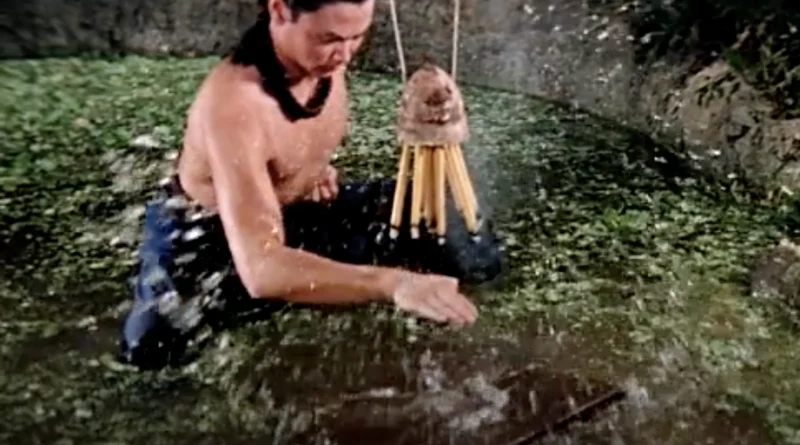
And what I mean about the training aspects is that while training was still heavily emphasized, the training itself wasn’t as well focused compared to other movies he would go on to do. Usually, a lot of the best stuff involves cause and effect where a pupil learns something that later gets repurposed (basically the kung fu version of Chekhov’s gun). For instance, in Challenge of the Masters, there’s a cool sequence with Wong Fei Hung slapping a floating plank in a pool as Lu Ah Tsai lowers lit incense/candles over Wong Fei Hung’s hands. However, that scene isn’t connected to a later usage like some sort of killing blow.
Also, while the martial arts is good here, it’s not great. While we do get to see Gordon Liu take on the master Lau himself, that fight isn’t all that noteworthy especially since Gordon Liu would play Wong Fei Hung again in Martial Club (1981) where we would get to see a serious kick ass fight between him and Wang Lung Wei. However, I would argue that Challenge of the Masters has a better story and flow compared to Martial Club but Lau’s filming of martial arts would improve over time as he would modernize the kung fu aspects.
Another critical aspect in the movie that I think gets under looked is the idea of mastery. One key insight Gordon Liu starts to understand as he develops his kung fu is that he realizes he’s not as good as he wishes. Lu Ah Tsai mentions how true mastery is the lifelong pursuit of self-improvement where there are no limits with kung fu. Yet in obtaining this “dissatisfaction” with oneself, it demonstrates the proper mentality in ones journey in mastering kung fu. This notion is partly the idea of humility because one has to realize there is no such thing as perfection and that one needs to practice and continue learning all the time.
The reason I think this idea of humility and learning is an underrated one is because it can apply to everything we do. For instance, early in my career, I became very cocky with my abilities with Perl. However, when the dot com bubble crashed, I was not only out of a job but could not find work. I had missed a gainful opportunity at the people search job because they were moving to Java. That whole incident made me realize that my skills weren’t good enough. As a technologist, having a sense of humility is important because of how frequently technology changes. You can never truly master the discipline and never believe yourself better than everyone. Instead, the real mastery is knowing that you must constantly improve and learn. So I take this movie’s core message to heart.