The Black Hole: Science, Technology and Possibly Technical Failures in the Movie
Recently, I had been thinking more about Disney’s The Black Hole as a result of some discussions on a Facebook group I belong to. One person posted an image of the infamous fireball/meteor scene and described it as “the best VFX ever!” Another person retorted something like, “Let’s not get ahead of ourselves” while someone else mentioned they preferred the effects in this movie to Star Wars (which sounds like a horrible take). With regard to that scene in particular, I can’t uphold it as a great moment mostly because the science behind it made no sense. And while others have examined various moments in the movie where the astrophysics break down (mostly regarding the black hole itself), I don’t think anyone has truly attempted to sit down and examine the various flaws of the movie in terms of the basic science, the technology and even how certain aspects were implemented. In turn, I wanted to try and enumerate various areas where the movie just loses me because of how bad one of these areas becomes.
Besides the recent Facebook group posting, another person that has influenced my view on the subject matter is Alan Dean Foster, who did the novelization. I think there’s a trivia note somewhere that talks about how Alan Dean Foster went to the Disney execs and pointed out the variety of scientific flaws in the movie. The fact that we still ended up with this mess of a script and movie show just how clueless the people in charge of this movie were as well as the probable not-so-hidden agenda of it attempting to emulate Star Wars the hope for a similar success. And while it’s been documented on how The Black Hole had been in development even before its actual release, the original bent had been altered a few times with various moments of script doctoring. But that merely demonstrates a few known issues just with the development of the script itself. From there, I would like to try and bullet point the various issues from memory about the movie (since it’ll be easier than creating sub headers).
- The Palomino craft – While the basic design of the craft seems plausible, one of the most glaring issues to me is the lack of size for that crew as well as the idea of deep space capabilities. It is unknown how far the Palomino crew travels in their mission but we do know that the black hole that they will encounter was not documented or seemingly known to the crew ahead of time. But that would put the crew very distant from Earth, which means that the craft would require a powerful propulsion system capable of light speeds or greater. Then if we add the fact that the ship is small, one has to wonder how long their supplies including food and air could last. We never see a sleeping quarters, kitchen or anything beyond two levels that were nothing more than instrumentation as well as some odd tunnel that Kate and Holland travel through.
- The black hole itself – Even though much of the idea behind black holes have still to be determined, what is certain is that they would not appear as a random whirlpool in space. Also, I think if a black hole is described as “the most massive” according to Vincent, you would think that humans would have documented its existence way ahead of time before some random craft shows up. I’m sure the various signals that it sends out should be detected way in advance.
- The mission to “find habitable life” – I’m sure Yvette Mimieux had no idea what she was saying. But if she recited the lines then it’s clearly the writers fault for being redundant here. The easy correction would have been for Kate to say, “find habitable planets” or worlds.
- Gravity’s usage – The movie does a rotten job portraying instances of zero gravity. One of the worst cases is during the initial tug by the black hole on the Palomino, Vincent stays at camera eye level while the rest of the ship starts to tumble. Even if the scene is meant to be humorous, it ultimately discredits the movie’s writers and direction in making it seem childish and stupid. Also, one the more infamous behind the scenes stories talks about how the original choice for Kate was Jennifer O’Neill. Jennifer was tasked to cut her hair short because of the way zero gravity would be handled. In turn, she ended up drinking a bottle of wine while having her hair done and ended up drunk, leading to a non fatal car crash and losing the part. Despite that situation, the idea of hair being affected by gravity only occurs in one instance where Reinhardt at the end appears like an old Rob Zombie with wild flaying hair just before his apparent “merge” with Maximilian. So I think the film makers were shoveling poor Jennifer and Yvette a lot of bullshit.
- Sound in space – At this stage, a lot of movies have been horribly offensive in the sci fi genre in allowing sound in space. The Black Hole does not help this cause at all.
- Anti-gravity – Along the way, Reinhardt apparently figures out how to implement anti-gravity for the Cygnus that can even withstand the black hole’s forces. Down the line, Reinhardt does talk about the way the reactor is powered through a new element called Cygnium but all of these things are so brief and contrived that they’re hard to believe. I suppose the idea of how the Cygnus handled anti-gravity before Reinhardt’s discovery alone makes no sense to me just because of the scale of the Cygnus. How would the original crew have dealt with being in space then? I could believe if the ship had limited gravity beforehand with its normal reactors to power the fields because then you could say the tech was developed on Earth. But there’s a massive leap to say that much of the power and tech were discovered later on.
- Laser blasters on the Palomino and the Cygnus. Both ships were meant to be science vessels. Why were lasers on either ship? I can somewhat believe the Cygnus because of the sheer size where one could argue that the crew anticipated hostile forces in the distant reaches of space. If not then I can see a nut like Reinhardt developing a laser on the side (he did come up with the sentries and Maximilian supposedly). The Palomino though is a strange case because it’s a much smaller vessel. In fact, Ridley Scott’s Prometheus was one of the few movies that I can recall that tried to address the idea of a science exploration needing weapons. In that case, you could see the paranoia of Vickers and her father in expecting possible hostile forces, which required a small military contingent. But at least they made an attempt to address the problem.
- Kate’s ESP link with Vincent – This is one of the dumbest ideas in the movie because they never explain how Kate has ESP with a robot. Alan Dean Foster did try to flesh out the details a little more in saying that Kate had an operation which implanted a chip in her brain to communicate with Vincent. Even that would make almost no sense because of how each person had a comm link attached to their jumpsuit. And there’s so many issues with the way the ESP was to be used such as how Kate could communicate through the metal shell of the Palomino against the black hole’s forces, the lack of explaining how far she was able to communicate with Vincent (she could apparently contact Vincent all the way from the command tower to the bow of the Cygnus where Vincent was when she was being taken in the elevator to the hospital). Also, there was a missing subplot that further developed Reinhardt’s intention to use Kate with her ESP to maintain communication with Vincent once the Cygnus entered the black hole. At this point, the idea of her ESP being this limitless two way communications device was too convenient since it gives the writers an easy way out. Also, once Kate sends the message about Alex and her fate after Maximilian’s attack, the entire subject of her ESP vanishes from the plot. The novel does try to utilize this ability at the end in talking about the weird unification effect Kate did in keeping the surviving members of the space probe intact in some metaphysical space but even then I think Alan Dean Foster just said fuck it because of how bad the real ending was.
- The really bizarre elevator platform – This is a technology/design issue that made no sense to me when you dissect it. The elevator from the inside the tower has a nonsensical design. First, there’s a small walkway that a person must cross to get access into the command center. The entire top half of the elevator is able to rotate around like some daytime game show’s prize showcase. Then there’s the matter of the electrified grid opening that eventually (and redundantly) further cauterizes poor Alex’s eviscerated form as he tumbles into the exploding grid. I can’t imagine that Reinhardt suddenly would implement such a wild design after the ship was built because the construction would require parts, time and prevent anyone from entering/leaving the command center, even after he gained control over the ship. That implies the actual designers were psychopaths in creating this safety hazard of a system. I know it’s meant to be used for dramatization (namely to hide the unseen gaping hole that Maximilian drills into Alex’s chest) but it’s such a stupid idea. A simple laser blast would have still been jarring for a Disney movie without the excessive violence that made that scene dumber than dumb.
- Maximilian’s design – Both Bob and Vincent obviously were meant to be The Black Hole’s version of R2D2 as utility type of robots. Maximilian was probably meant to mirror Darth Vader (and by the end of Star Wars, it’s unclear that Vader was human at all). But to make Maximilian be as intimidating or attempt to be scarier than Vader, they gave him a devilish coloring as well as an ominous pair of rotating blades. While we got to see what Maximilian ended up using those blades for, in practice they seem pretty useless. Both Vincent and Bob are armed with lasers that they can charge up on their “arm” extensions. The sentries are given dual wielding laser pistols. But Maximilian has a melee device? It seems quite backwards to design an inefficient weapon into the robot unless Reinhardt also was a sadist and developed the weapon to inflict grievous punishment on the original crew (perhaps how Frank was murdered which we never found out in practice). Again, the drama overshadowed any logic for the design here.
- The sentries themselves – As far a we know, Reinhardt apparently crafted the sentries during the mission, starting with STAR as the prototype. It seems outrageous where the original crew of the Cygnus were unable to detect Reinhardt crafting in some secret section of the ship a small army of robots along with laser pistols. Even if Reinhardt only crafted STAR initially, how could a clumsy, slow robot like that single-handedly manage to overcome the crew? There’s just so many questions left unanswered in terms of how Reinhardt managed to pacify the Cygnus crew because of how incompetently they were unable to beat the tinier Palomino gang. The sentries were worse than Stormtroopers and COBRA infantry combined in terms of sheer lack of ability.
- Cygnium – This new element that Reinhardt “discovers” supposedly is the main thing that powers the reactors. I believe Booth or Reinhardt may have mentioned that the Cygnus’ reactors could power the entire earth, which is ridiculous (especially now that we’re experiencing a power crunch from data centers). Nonetheless, this idea was so tiny in the scheme of things but it leaves a lot to be desired. How was this element discovered? Does the proximity to the black hole have any relevancy for how Reinhardt makes this discovery? How does one farm such an element and deploy it into an existing reactor that is used to power an entire, massive deep space ship? What other properties does it have beyond simple power? Horribly underdeveloped piece that deserved more attention because it could’ve been something to explain a variety of technology and science problems if the makers even bothered.
- The humanoids – I don’t want to go into the transformation process because that deserves a whole line item by itself. But there’s a lot of issues I have in the way the humanoids were handled. For instance, it’s never established whether they (the humans) still require food, water, bathroom breaks, sleep, etc. We do know that the humanoids can breakdown (which actually makes sense) but they’re never given much development outside of being faceless entities we’re supposed to sorrow for. The fact that there is a crews quarters that Holland explores with beds and a massive garden that was known to Booth beforehand (he talks about writing on the subject, even though he randomly discovers it first hand during his solo voyage). To me those things partly imply that the humanoids still required a minimum amount of basic human needs, even though they probably couldn’t express those needs much anymore. Previously, I harped on Holland’s lack of dialog during the crews quarter exploration scene because we don’t know what he’s thinking as he searches one of the rooms. I think a small line during the dinner scene where he could say that the quarters were still in use (like a rumpled up bed) would imply that there were survivors (which I think someone suggest). The fact that there’s no direct connection made about the scale of the garden and the crews quarters make those scenes a little odd and almost useless.
- The entire shooting gallery – Why does this thing even exist on a science exploratory ship? More importantly, why would robots need any kind of recreation, especially robot guards? Because of the rise of AI in the past few years, one could argue that the sentries required target training (and apparently they did in the movie because they barely could hit anything). But at the same time, Hollywood tends to not know much about the technical details of complex science and engineering matters like AI. Since this movie is set into the future, one might think that robots already had accuracy programmed. Nonetheless, the real issue is that the room was presented more for recreation than for training (STAR does his fancy shots). The whole aspect felt like a worthless scene that added absolutely nothing and took away a significant amount of time in distracting the audience from the plot. Then we have Bob who is amongst the sentries. We know that Bob isn’t armed and supposedly is a maintenance robot. Why is he there? He knows that STAR is in the room too. So what function does he serve just sitting around? Why would the sentries even welcome him inside? It’s not like he’s hiding either.
- STAR – The robot makes almost no sense at all. Besides Maximilian, STAR is the only other robot from the Cygnus crew (and Bob) that exhibits any form of emotion. He’s obviously there to serve as a one off joke for the film makers but he adds almost nothing to the plot. We get this great background on him being the #2 and the leader for the rest of the sentries. Then Vincent randomly triangulates a shot that destroys him. It’s so goofy and bad that it’s another thing that frustrates me to no end. On top of that, why didn’t the rest of the sentries respond to Vincent destroying their leader? They merely stand around staring dumbfounded at STAR while he’s in the throes of his last moments. He doesn’t even get repaired for some minor revenge plot against Vincent. So again, this character added absolutely nothing to the plot and wasted essential time.
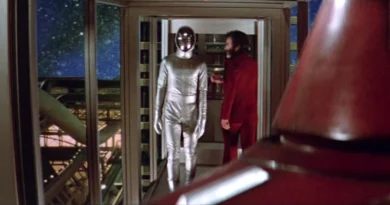
- The space probe’s silver humanoid suited operator – This is another really bizarre cameo who shows up in two different scenes. We never learn just whom this pilot is beyond how he does a final experiment (which is left unexplained) to confirm that the Cygnus is ready to enter the black hole. All we learn is that Reinhardt intends to “personally” check out his computers, which is an odd line. Now, Reinhardt did stay to inspect the space probe after the pilot and Maximilian leave so Reinhardt might’ve implied that he was going to examine data from the space probe’s computers. But the way Reinhardt stated it made me think the actor had no idea what a computer really was and that he might’ve believed the pilot was a robot himself. Also, I think Reinhardt talks about a debriefing room where Maximilian escorts the pilot but anything dealing with that never is shown. The biggest issue I have with this pilot is that Reinhardt sent a semi-living being to the event horizon of the black hole for a high risk experiment rather than a robot or sentry even. The movie never explains what an event horizon is nor why it’s significant or how it makes any impact to the plot. My theory is that the space pilot’s experiment was to determine the effects of radiation and other particles on a person. Hence, why the pilot required a special silver uniform. The debriefing could’ve hinted that the pilot suffered no ill effects from the proximity of the black hole. Maybe the humanoid shown in the hospital receiving the treatment was the same one used here. Either way, there’s a variety of continuity issues that could’ve been interconnected better if the film makers these things through a little better.
- The hospital – I wouldn’t debate the need for a space hospital but the portrayal in this movie is one of the worst aspects. You have these weird rotating tables with six laser pods that beam who knows what into their patients. In the center, sits some faceless surgeon. We never see how the operator can even get in and out of the center (Holland does show himself leaping over but he’s not in a zombified state). These tables are only shown to administer some sort of brain programming where the lasers themselves have no overt purpose but can penetrate one of those thick reflective face masks yet destroy a sentry’s head. But is the audience expected to, without argument, accept how a futuristic hospital is run? For instance, were these tables here before the take over? If they were, how did an actual patient handle a critical injury like a knee breaking? Did those lasers simply serve a more universal patching? I believe Logan’s Run (which is from 1976) showed a weird surgery with a laser that could repair skin. I wouldn’t doubt that the brain surgeons reprehensible…i mean responsible for this film (mis-)appropriate the idea here to a lesser degree without thinking how it ought to be executed. But the way this hospital and these devices are presented make me think that they were “invented” once Reinhardt overcame the ship’s crew. The rotating aspect (though probably nothing more than a futuristic James Bond style damsel in distress trope with woman tied up on the train tracks with the impending train or saw) could be justified in terms of expediently converting a large number of the crew in batches. Even then, why six body molds per table especially when there’s three tables visible in the room? Just how big was the original crew? And why would someone need to move from one laser endpoint to another? Did each laser per table serve a different purpose? If this whole transformation process wasn’t so critical to the plot (where it’s literally one of the biggest plot devices in the movie), I wouldn’t be as upset for the horrible lack of logic and explanation.
- The lack (or lax) of security on the doors and around the hospital. Reinhardt talks about certain “dangerous experiments” but I feel that the only one he needs to hide is the hospital. Given that, why didn’t the hospital doors have a lock of any sort? How were Vincent and Bob able to enter or Holland later on? Shouldn’t there be more security around that spot especially with the Palomino crew possibly discovering it (which they did)? I mean in both scenes, the sentries do show up gradually but it’s too late for them to be effective. In each situation, they get wasted by Vincent (the ones on the outside). Again, how can security be this bad and manage to take over this massive ship and crew when they can’t handle two minor league robots and two cowboy type of pilots?
- The general inconsistency of communication used for the robots – I presume that the robots communicated on some radio frequency given that the internet wasn’t well established when this movie came out. The most noticeable cases of where the sentries communicate with one another are the scenes when STAR confers with the other sentries before accepting Vincent’s challenge in the shooting gallery and later during the hand off of Kate from the aircar. While Bob does try to establish that the two destroyed sentries outside the hospital might eventually be discovered, Bob mentions that it would happen during a patrol that encounters the area (which does happen). But one would think because these are robots, the system managing these robots would notice an offline blip. Otherwise, how do these sentries actually communicate with one another? Along those lines we have the weirdly loud alarm that resounds after Reinhardt decides to terminate everyone. Just who is this obnoxious klaxon for? Why would the sentries require an audio component except from direct verbal orders from Reinhardt to perform any function?
- Communication’s spying network – Reinhardt admits that he was spying on the Palomino by monitoring their frequencies. So he knew at least that the Palomino made a few attempts to contact the Cygnus. Also, one can infer that Reinhardt was able to monitor all communications within the Cygnus, which is why he questioned how the crew figured out to be recalled without his knowing (until he deduced that Kate’s ESP to Vincent was responsible). But if he had that level of spying capability, how is it that the Palomino manages to avoid notice in various cases?
- Reinhardt keeping his formulas on physical paper – Okay, again this is an old movie so the film makers had almost no clue about the emergence of computing. But why store just a single copy in one mega notebook? Why weren’t his ideas and formulas Xerox’d or stored into some computer? Numerous movies would show tape reels and there were typewriters by that point. Just a terrible scientists.
- Kate’s (invisible) arm restraints while riding in the air car and in the deleted scenes in the hospital. One unseen aspect was what the sentries used to bind Kate’s arms behind her back. Again, this is a poor design for the sentries because of how they’re treated more like an ominous space gestapo police robot force. Even so the idea that the Cygnus would have something like cuffs seem ridiculous. I mean I guess Reinhardt could’ve welded some together given he made the sentries, Maximilian and who knows what else onboard. But we never see the sentries carry anything beyond their holsters that are visible on their uniforms. So I have to question what was used to restrain Kate’s arms.
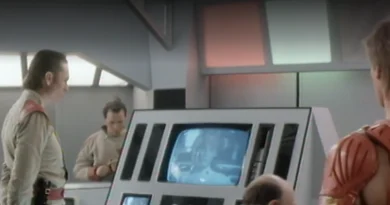
- Inconsistent placement of video cameras for security. We do see Reinhardt visually monitoring Dan, Kate and the two robots’ escape after the shootout scene. Also, there’s the brief display of the destroyed Sentry’s head. But one would think the entire ship would have monitors for a variety of reasons. How is it that Reinhardt was unable to keep track of Dan and the two droids during the rescue mission? At some point, Reinhardt becomes aware of the Palomino crew’s potential for endangering his goals and he sets up an alert on the ship. But why doesn’t he have the ability to see the various halls Holland sneaks through? Unlike say the alien in Ridley Scott’s Alien, Holland the two robots aren’t using hidden shafts to crawl around in order to avoid the sentries. But that didn’t mean he should have been able to avoid video surveillance. And why wasn’t Bob tracked since he was a Cygnus robot? Why would an untrustworthy maintenance robot deserve autonomy?
- The infamous silver bag and foil cap. Again, I’ve ranted over these things so many times, I could easily do a PhD on them if someone would sponsor me. But I’ve had so many issues about these two devices like how does Kate get put in, why a foil cap is used over Kate’s head, how does Kate not try to roll off the table, etc. For the purpose of this blog, I’m going to simplify all that (since I have written better dedicated posts) and just say that they are major problems that need to be resolved.
- I already devoted a blog to Kate’s rescue and the problems with the hospital. So I don’t want to go through all that again. Instead, I’ll just say read the previous blog and that the whole scene is problematic from start to finish on a variety of levels.
- The hospital escape where Kate and Holland use the humanoid robes for disguise. I have to wonder just where they acquire these spare robes and masks. The movie doesn’t delve into the rest of the hospital beyond the operating tables and anything inside. We don’t get to see where the storage lies (where I assume the silver bag and foil caps are kept) and any robes and masks for recent converts. Also, we don’t get to see Holland freeing Kate from the bag itself, which is highly disappointing.
- I don’t want to get into the next major shootout because the entire scene is stupid. But it just reinforces my view that the sentries were highly incompetent.
- Booth’s attempt at an escape. This part is so deranged. How and why should Booth know what to do with the Palomino? Obviously, he’s not a good pilot and struggles. But not once is it ever established that as a reporter he required any form of training with the ship. It’s about as equally preposterous as having a news reporter taking up a life support spot on a science mission.
- The damage from the Palomino’s crash. I assume that the Palomino’s crash landing into the Cygnus starts the issues with the other failures especially in having a damaged hull to repel the meteor storm. We just see it happen and there’s no mentioned consequence outside of how Booth ironically did the remaining crew a favor.
- The greenhouse fight. Another stupid fight scene. When the roof gets torn off by a meteor, I think the humans should have been killed whether by the depressurization effect, the possibility of radiation from the black hole or other particles that the Cygnus’ failing anti-gravity and shields no longer could withstand. Then you have the weird effect where a few sentries get carried out of the ship into space. Whereas before they were deactivated when they get blasted but manage to stay on their feet. It’s just a big mess.
- Bob “freezing” after the greenhouse scene. Another really corny scene.
- The air car chase scene. Supposedly, the Palomino team was being chased by another group of sentries but that section got eliminated. I’m guessing the intent was to eventually sell a ride at Disneyland but I think the general negative public response killed off any future plans that Disney may have wanted for this franchise. Nonetheless, at one point, the aircar stops before a damaged portion of the track which has been clearly blown off. There’s no air suction like the greenhouse scene and the humans aren’t wearing any space suits to protect them. They merely take a different exit to escape with no consequence.
- The fireball/meteor scene has already been discussed but I’m sure anyone who sees it must think the film makers got fails in astronomy. The less said the better.
- The final run towards the space probe. Just a purely stupid scene. I get that the actors had no desire to wear space suits. But it just convinces me that the film makers had such poor controls over the film and this scene suffers massively once Pizer starts drifting off into space. To a lesser degree, one could argue that Holland and Kate may have survived attempting to board the probe with whatever gravity and atmosphere were left being generated around them. But Pizer spinning away and not imploding was utterly stupid.
- The tiny size of the space probe. I think for the spiraling effect of the survivors spinning uncontrollably, the film makers decided to have a tight quarter for the interior. However, the ship has no known food supply, no bathroom, an unknown amount of oxygen remaining and once it exits the black hole (from a white hole?) it can be seen heading towards a planet that happens to be right outside. But the main issue is that this was a small probe ship not an interstellar thing like the Cygnus. Even if the crew managed to survive the voyage, how could they be expected to survive much longer in the new universe? Would Kate and Holland resort to cannibalism on Pizer? I mean, it’s so stupid and desperate where it reeks of the film makers just saying fuck it we’re out budget let’s just finish this because there’s these bullet points that Disney wants us to handle.
- The Hell/Heaven view. Even though the overall idea is utterly absurd, preachy, self indulgent and almost incomprehensible, I can buy the visual as a hallucinogenic, feverish nightmare that one of the crew members (Kate?) experiences during their voyage inside of the black hole. If my brain was being rattled that badly while my body was being crushed by intense gravitational forces, then why shouldn’t a person experience something like the worst LSD trip known to man?
- The weird bright planet outside of the black hole/white hole’s exit. Oddly, I buy the Hell/Heaven piece more than I do the chances of a nearby planet that the film suggests (or perhaps that thing being a neighboring star in orbit). But the real issue goes back to the remaining fuel and life support available on the space probe to be able to transport three humans to this random system/planet. Even if the black hole’s exit process slingshotted the probe at a high enough velocity through its rear end, how can this piece of serendipity be close enough before the crew perishes for lack of food or oxygen? They never establish if the experience of traveling through a black hole actually extends life as Reinhardt tries to insist. So again the ending just has a “fuck it” feeling that lacks resolution much like a good chunk of the movie in its inability or willingness to sit down and explain anything.
So there you have it. All the absurdities I could think of from a variety of scientific, technological and technical viewpoints. I think if someone (beyond myself) ever attempted to salvage this movie, they ought to examine my two latest blogs to see the various discrepancies and massive leaps in logic or need of further expatiation before doing a proper re-write.